
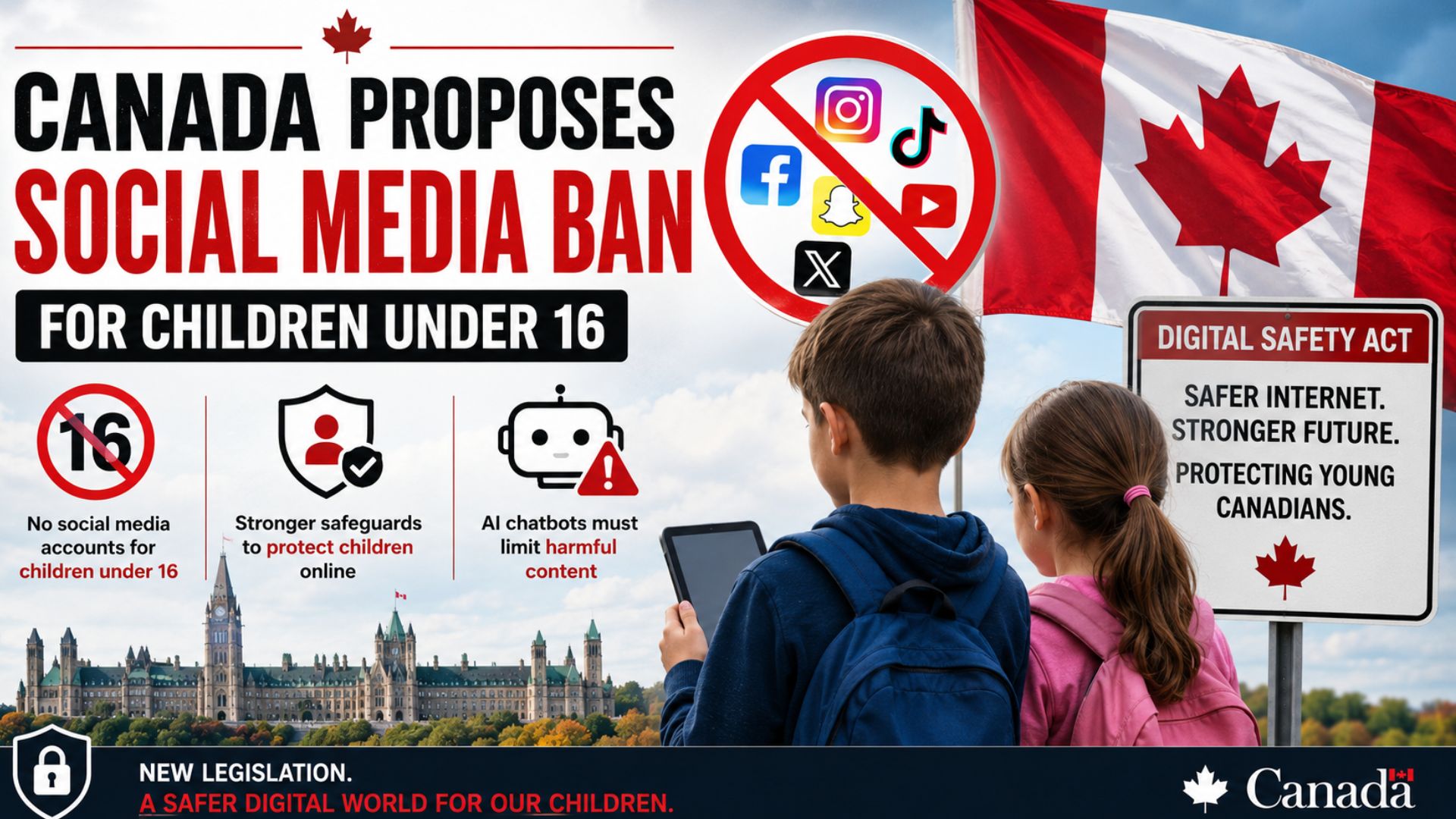

The Canadian government has introduced a new bill that would ban children under the age of 16 from having social media accounts and place stricter rules on artificial intelligence chatbot services. The proposal aims to improve online safety and reduce the risks children face on digital platforms.
Culture Minister Marc Miller presented the legislation, known as the Digital Safety Act, on Wednesday. If approved, the law would make Canada one of the latest countries to tighten regulations on social media companies over concerns about their impact on young users.
Government Says Child Safety Must Come First
Announcing the proposal, Miller stressed the need for stronger protections online.
“We have seen the very serious consequences that online harms can have…The safety of children cannot be an afterthought,” he said.
Under the proposed law, social media companies would not be allowed to provide accounts to children younger than 16. However, the government plans to create an exemption process for companies that can prove they have strong safety measures in place to protect younger users.
The bill also targets adult-content platforms and other online services. These companies would need to reduce the risks linked to harmful material and clearly label content created using artificial intelligence or other synthetic technologies.
Heavy Penalties for Companies That Break the Rules
The government plans to establish a Digital Safety Commission to enforce the new regulations.
Companies that fail to follow the rules could face significant penalties. The proposed law would allow regulators to impose fines of up to three percent of a company's global revenue or CAD$10 million.
Health Minister Marjorie Michel said the legislation would help create a healthier environment for young people.
“This legislation will provide a safer environment for young Canadians and empower them to connect in-person, build friendships, focus in school, and learn real-world skills so they can thrive,” she said.
Experts Welcome the Move
Education experts have largely welcomed the proposal.
Sachin Maharaj, a professor at the University of Ottawa, described the plan as a positive step.
He said the proposal reflects growing recognition that social media can contribute to behavioural and social challenges among young people.
“Obviously, kids will find their way around” restrictions, he told AFP. “But the real challenge is to change the way the apps work.”
New Rules for AI Chatbots
The legislation would also introduce regulations for AI chatbot services, which have become increasingly common in everyday life.
Companies operating chatbots would need to take steps to reduce the risk of their systems generating or sharing harmful content. They would also have to improve transparency around crisis situations.
The proposal would require firms to establish clear reporting standards when users express intentions to harm themselves or others.
Debate Intensifies After Recent Tragedies
The issue has received greater attention in Canada following a mass shooting in April in the mining town of Tumbler Ridge. Nine people, including the gunman, died in the attack.
The incident renewed debate about the responsibilities of AI companies. Last year, OpenAI faced criticism after banning the shooter from its platform because of concerning conversations on ChatGPT. However, the company did not alert Canadian police, saying it found no evidence that an attack was imminent.
Part of a Global Push for Online Safety
Canada's proposal follows similar actions in other countries. In December, Australia became the first nation to require platforms such as TikTok, YouTube and Snapchat to remove accounts belonging to users under 16 or face substantial penalties.
Meanwhile, Indonesia started enforcing its own ban on social media access for children under 16 in March. Several European governments have also signalled plans to introduce comparable restrictions as concerns grow over children's online safety and the influence of digital platforms.
The proposed Digital Safety Act highlights Canada's effort to strengthen protections for young internet users while also placing greater responsibility on technology companies and AI developers.