
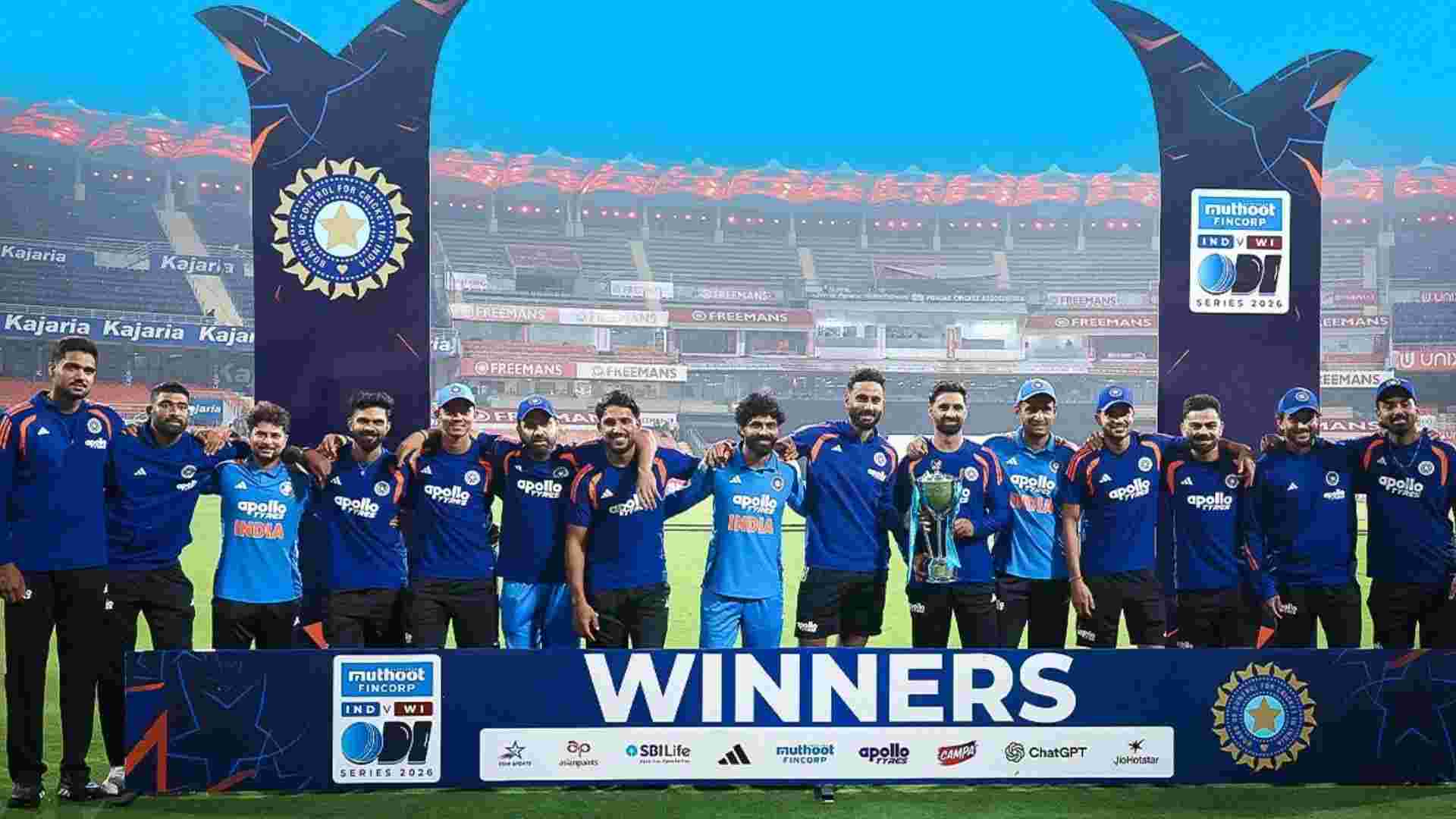

West Indies pulled off a record chase against India by five wickets in the third ODI of the three match series at New Chandigarh in Mohali. After being asked to bat first, India suffered two early blows as Jayden Seales dismissed Shubman Gill and Virat Kohli with consecutive deliveries. Rohit Sharma then added a blazing-fast 137-run partnership for the third wicket with Ruturaj Gaikwad before being dismissed by Keemo Paul in the 25th over.
Ruturaj Gaikwad scored 57 runs off 69 balls before falling to Seales. KL Rahul then added a valuable 65 runs for the fifth wicket with Naman Dhir. Rahul also built important partnerships with Anshul Kamboj and Gurnoor Brar. A superb unbeaten century from KL Rahul helped India post a huge total of 351/7 in 50 overs. Jayden Seales (3/62 in 10 overs) was the best bowler for West Indies, while Keemo Paul also claimed two wickets.
In reply, John Campbell and Shai Hope gave West Indies a flying start. They added a quick 41 runs for the first wicket in just 4.1 overs. Shai Hope then put together a 109-run partnership for the second wicket with Amir Jangoo. Hope kept his composure throughout the chase and played a superb unbeaten innings of 162 runs off 143 balls, guiding West Indies across the finishing line with 10 deliveries to spare. Naman Dhir (1/33 in 5.2 overs) was India's best bowler, while Mohammed Siraj, Kuldeep Yadav and Gurnoor Brar also took one wicket each. With this victory, West Indies prevented India from completing a clean sweep of the series. India, however, won the three-match series 2-1.
Hope Leads a Remarkable Chase
Hope was the central figure in the successful chase, scoring 162 from 143 deliveries. His innings was carefully paced, with West Indies keeping control for most of the pursuit. The asking rate did not cross eight runs per over until the end of the 38th over. That was also when Hope's fitness began to become a serious concern. He was no longer able to put pressure on the fielders or consistently attempt big shots. During that period, he went 42 deliveries without hitting a boundary. Even reaching his 21st ODI century brought little celebration because of the physical strain he was experiencing. Among West Indies players, only Chris Gayle has scored more ODI centuries. Keemo Paul played a vital supporting role during this period. Much like Amir Jangoo earlier in the innings, Paul took responsibility for the scoring and allowed Hope to conserve his energy. This gave the West Indies captain an opportunity to recover and attempt to finish the chase himself. Paul had already made a major contribution earlier in the match by dismissing Rohit Sharma for 92 in the 25th over. Rohit had battled through the early pressure and appeared ready to push towards another big hundred. A century would have been his third in four innings.Rohit and Rahul Rescue India
India were in serious trouble early in their innings after Jayden Seales, who had been West Indies' standout bowler throughout the series, removed Shubman Gill and Virat Kohli with successive legal deliveries. Gill edged the ball onto his glove down the leg side, while Kohli was beaten by a straight delivery that crashed into his middle stump. India were reduced to 4/2 and needed experience at the crease. Rohit and Rahul responded with composure. Given how easy batting became once the pitch settled, India needed substantial contributions from both players. West Indies, however, made the task harder for themselves. They dropped at least six catches, produced several poor efforts in the field and eventually lost control with the ball during the closing overs. Ruturaj Gaikwad was particularly fortunate, surviving four dropped chances before eventually being dismissed for 57 from 69 balls. His dismissal came from a sharp lifter delivered by Seales. Rahul then helped India rebuild the innings for a second time. He added 40 runs with debutant Anshul Kamboj and another 61 with No. 9 Gurnoor Brar. Rahul remained patient deep into the innings before taking full advantage of the final three overs. India's slow over-rate meant an additional fielder had to remain inside the circle, and Rahul punished the bowling accordingly. He scored 42 runs from the final 12 balls he faced as India collected 50 runs from the last three overs. Rahul's century was his ninth in ODIs and his fourth in only 36 innings while batting at No. 5.West Indies Overcome Injury Problems
West Indies suffered another injury setback when Naman Dhir held onto a catch to dismiss one of India's batters. The catch also resulted in opening batter Jewel Andrew sustaining a serious injury. Andrew was taken to hospital for scans, although no fracture was detected. The pain was severe enough for West Indies to decide that Andrew would only bat if absolutely necessary. Fortunately for them, the situation never required his return to the crease. West Indies also lost Vitel Lawes to injury during the bowling innings, forcing the team to manage its resources carefully. Despite those setbacks, their chase remained on track. Mohammed Siraj, returning to the Indian side, bowled John Campbell early with a wobble-seam delivery. However, West Indies responded strongly and quickly put India under pressure.Jangoo and Hope Put West Indies in Control
Amir Jangoo, one of the biggest discoveries of the series, benefited from being promoted to No. 3. The move allowed him to take greater advantage of the field restrictions. Jangoo was dropped on 34 by Virat Kohli, and he made India pay for the mistake. He scored 67 from 56 balls and added 109 runs for the second wicket with Hope. The pair played with considerable freedom, attacking the Indian bowlers and taking a run almost every ball from Kuldeep Yadav. Their partnership put West Indies firmly in control. Jangoo's impressive series eventually ended through a run-out following a misfield by Kohli. He finished the series with 239 runs from only 176 deliveries. When Jangoo departed, Hope had scored 62 from 62 balls. With the specialist batters almost exhausted, he needed to reassess his approach. West Indies still required 202 runs from just under 30 overs, but the way batting had dominated the previous 60 overs made the target appear manageable. Hope immediately responded by hitting three boundaries from his next eight deliveries. India then suffered another injury concern when Brar briefly left the field with a calf problem. Dhir filled in effectively during Brar's absence, but Hope continued to find boundaries whenever West Indies needed them. One of his best shots came in the 26th over when he hit a straight six off the back foot after Dhir had bowled three consecutive dot balls.Controversial Rutherford Dismissal
Sherfane Rutherford soon joined Hope in the attack, but his innings ended in controversial circumstances. He was given out for 24 from 25 balls when West Indies were 206 for 3 after 30 overs. Rutherford reviewed the decision, but the DRS failed to provide enough evidence for the third umpire to overturn the on-field call. The replays showed his bat and pad making contact at almost the same time, but the third umpire could not identify a "clear gap" between the bat and ball. Many observers believed the decision should have been overturned, leaving West Indies with another difficult situation to overcome. Despite losing Rutherford, the equation remained highly favourable. West Indies needed 146 runs from the final 20 overs with seven wickets in hand. However, they did not have Roston Chase, who had been left out in favour of Gudakesh Motie. Motie also had to spend a significant part of the bowling innings on the field because of the injury to Lawes.Hope Takes the Chase Deep
Paul played an important supporting innings, using several leg-side glances to keep the scoreboard moving. Hope, meanwhile, decided to take the chase as deep as possible. He was aware that India's slow over-rate would eventually force them to bowl with an additional fielder inside the circle. Even after Brar returned and dismissed Paul, Hope remained at the crease and prepared to take responsibility for the final stages. The asking rate reached a maximum of 11.2 runs per over during the final five overs. Hope was receiving little support from Motie and had scored only 38 runs from his previous 48 deliveries. Then he began attacking again. Hope struck a straight six from the first ball of Kuldeep's final over. He then produced another important response by sweeping a wrong'un for four. That delivery was particularly significant because a similar ball had dismissed him in both of the previous matches. India entered the final four overs under the pressure of the over-rate penalty, and their bowling began to fall apart. Hope hit two boundaries off Brar in the 47th over. In the following over, Gill opted to give Kamboj the ball even though Siraj still had two overs remaining. Kamboj attempted to use his IPL-style approach of bowling from around the wicket and targeting wide yorkers against right-handed batters. However, he failed to execute the plan and also bowled a no-ball. By that stage, Hope had already taken control of the chase, but the extra delivery gave West Indies another valuable opportunity to finish the job.Brief Scorecard
India (IND) : 351/7 (50)
KL Rahul 129*(87), Rohit Sharma 92(85), Ruturaj Gaikwad 57(69);
Jayden Seales 3/62(10), Keemo Paul 2/71(9)
West Indies (WI) : 352/5 (48.2)
Shai Hope 162*(143), Amir Jangoo 67(56), Keemo Paul 44(35);
Naman Dhir 1/33(5.2), Mohammed Siraj 1/52(8)
Player of the Match: Shai Hope
Player of the Series: Shubman Gill
Shai Hope spent almost the entire match on the field and still managed to produce a remarkable performance for West Indies. After keeping wickets for all 50 overs, Hope struggled with his fitness during the final third of his innings. Despite the discomfort, he remained at the crease and guided West Indies to their highest successful chase in ODI cricket.
The victory came only days after West Indies suffered the heartbreak of losing a match despite scoring 405 runs against India. This time, they chased down a huge target of 352 with surprising comfort, even after losing one of their five specialist batters to injury before Hope himself began to struggle.
This was the only match in the series in which West Indies had to chase. The batting-friendly conditions in New Chandigarh became even more obvious as the game progressed. India had decided to bat first after winning their third toss of the series, looking to test themselves. The opening 10 overs produced only 28 runs for two wickets, but the remaining part of the match saw 675 runs scored at an extraordinary rate of 7.64 runs per over.
India produced several impressive batting performances, including KL Rahul's highest ODI score. However, their bowling attack, without Jasprit Bumrah and Hardik Pandya, provided little confidence with the World Cup less than a year away. It also raises another question: what might have happened if India had not won all three tosses and West Indies had been able to chase earlier in the series? Stay tuned with JUSZNEWS for regular updates!