
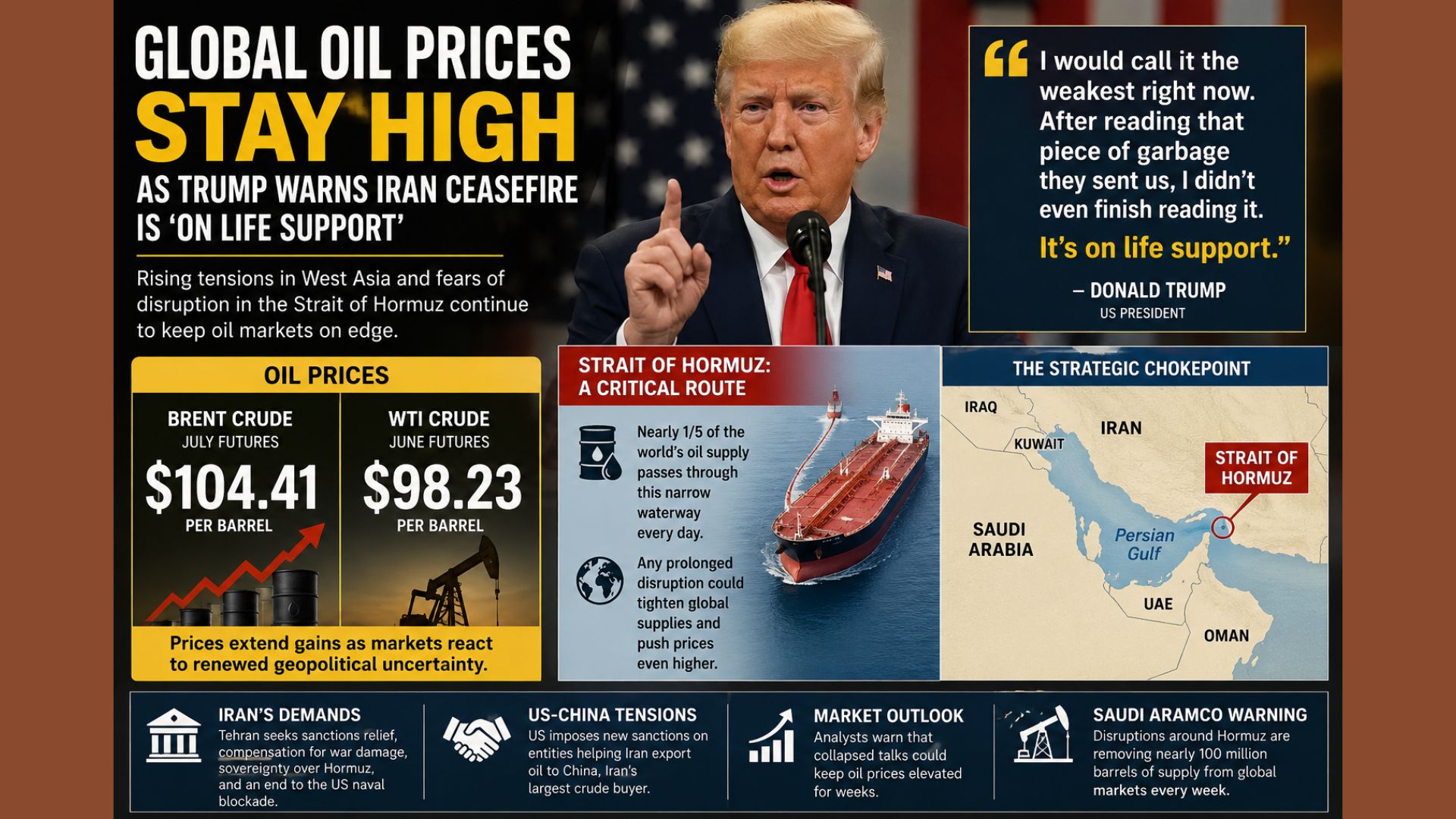

Global oil prices remained elevated on Tuesday after US President Donald Trump warned that the fragile ceasefire with Iran was close to collapse. His remarks increased fears that the ongoing conflict in West Asia could intensify again and continue disrupting global energy supplies through the Strait of Hormuz.
Brent Crude Stays Above $104 Per Barrel
Oil markets reacted sharply to the renewed geopolitical tensions. Brent crude futures remained above $104 per barrel, while US benchmark West Texas Intermediate (WTI) traded close to $98 per barrel.
In early trading, Brent crude futures for July delivery stood at $104.41 a barrel. WTI crude futures for June delivery traded at $98.23 per barrel. The latest rise extended gains from the previous trading session as investors worried about fresh instability in the Gulf region.
Trump Rejects Iran’s Response to Peace Proposal
The jump in oil prices came after Trump strongly criticised Iran’s response to a US peace proposal. “I would call it the weakest right now,” Trump told reporters at the White House.
“After reading that piece of garbage they sent us, I didn’t even finish reading it. It’s on life support,” he added. Trump’s comments raised concerns that diplomatic efforts to calm tensions in the region may be collapsing only weeks after hopes of de-escalation emerged.
Strait of Hormuz Remains Key Concern
The ongoing conflict has already disrupted shipping through the Strait of Hormuz, one of the world’s most important oil transit routes.
Nearly one-fifth of the world’s daily oil supply passes through the narrow Gulf passage. Any long-term disruption there could tighten global crude supplies and increase inflation pressures worldwide.
Iran Demands Sanctions Relief and End to Naval Blockade
Reports said Tehran responded to Washington’s proposal with a list of broader demands linked to regional conflicts. Iran reportedly asked for compensation for war damage and reaffirmed its control over the Strait of Hormuz.
The country also demanded that the United States:
- End its naval blockade
- Lift economic sanctions
- Guarantee no future attacks
- Remove restrictions on Iranian oil exports
The response also reportedly included references to the fighting in Lebanon involving Hezbollah and Israel.
Trump Mentions Iran’s Uranium Stockpile
Trump also claimed on Monday that Iran was willing to hand over what he described as “the nuclear dust”. He appeared to refer to Iran’s enriched uranium stockpile and claimed that only the United States and China had the capability to retrieve it.
However, he did not provide further details about the statement.
Markets Fear Prolonged Conflict
Analysts said markets are now increasingly preparing for a longer conflict instead of a short-term disruption.
Experts warned that oil prices could remain high for several weeks if tensions continue around key Gulf shipping routes.
US-China Tensions Over Iranian Oil Continue
The Iran crisis is also expected to dominate discussions when Trump meets Chinese President Xi Jinping later this week. Washington has increased pressure on Beijing over its continued purchases of Iranian crude despite Western sanctions.
The US Treasury Department on Monday announced fresh sanctions against entities accused of helping Iran export oil to China. China remains Iran’s largest oil buyer.
Saudi Arabia Warns of Major Supply Disruptions
Saudi Aramco chief executive Amin Nasser warned that disruptions around Hormuz are removing nearly 100 million barrels of supply from global markets every week. Saudi Arabia has already redirected part of its oil exports through western ports outside the Gulf.
However, traders said supply bottlenecks and rising freight costs are still keeping global oil markets under heavy pressure.