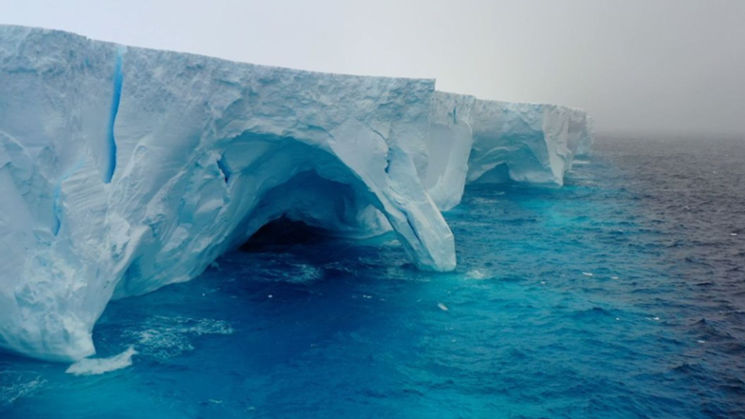
The world's largest iceberg, A23a, has become stuck in shallow waters near South Georgia, a remote British island home to millions of penguins and seals. The iceberg, nearly twice the size of Greater London, appears lodged on the island's southwest coast. Scientists expect it to break apart gradually. However, fishermen worry about navigating through large ice chunks, and some macaroni penguins that feed nearby may struggle to find food.
A Natural Cycle with Unexpected Consequences
Despite concerns,
Antarctic scientists highlight potential benefits. As the iceberg melts, it will release a significant amount of nutrients into the ocean. "It's like dropping a nutrient bomb into the middle of an empty desert," says Prof Nadine Johnston from the British Antarctic Survey.
Ecologist Mark Belchier, an advisor to the South Georgia government, warns that if the iceberg breaks apart, drifting ice chunks could endanger vessels and restrict access to fishing grounds.
The Iceberg's 40-Year Journey
This event marks a new chapter in a story that began nearly four decades ago. The iceberg broke away from the Filchner–Ronne Ice Shelf in 1986. Scientists tracked it via satellite, and after years of being trapped in an ocean vortex, it finally moved north in December. As it drifted through the warmer "iceberg alley," it remained largely intact. By mid-February, it had accelerated to about 20 miles (30km) per day.
"The future of all icebergs is that they will die. It's very surprising to see that A23a has lasted this long and only lost about a quarter of its area," says Prof Huw Griffiths, speaking from the Sir David Attenborough polar research ship in Antarctica.
On Saturday, the towering 300m iceberg struck the shallow continental shelf, about 50 miles (80km) from land, and now appears firmly grounded.
Signs of Decay and Environmental Impact
Scientists believe the iceberg will remain in place until chunks break off. "It's probably going to stay more or less where it is, until chunks break off," explains Prof Andrew Meijers from the British Antarctic Survey.
Once covering 3,900 sq km (1,500 sq miles), the iceberg has steadily shrunk as it sheds water into warmer seas. Now, it measures about 3,234 sq km. "Instead of a big, sheer pristine box of ice, you can see caverns under the edges," Prof Meijers adds.
Tides will push the iceberg up and down, causing it to grind against the continental shelf, eroding both the ice and the rock beneath. "If the ice underneath is rotten—eroded by salt—it'll crumble away under stress and maybe drift somewhere more shallow," he explains.
Meanwhile, tiny marine creatures like coral, sea slugs, and sponges living on the seafloor will face destruction. "Their entire universe is being bulldozed by a massive slab of ice scraping along the sea floor," says Prof Griffiths. While this is catastrophic for these species in the short term, he notes that it is a natural part of the region’s ecological cycle. "Where it is destroying something in one place, it's providing nutrients and food in other places."
Impact on Wildlife and Human Activity
Initially, scientists feared that larger wildlife on South Georgia would suffer. In 2004, an iceberg in the Ross Sea disrupted penguin breeding, leading to high mortality rates. However, experts now believe most birds and animals will avoid major threats.
Some macaroni penguins that feed on the continental shelf where the iceberg is grounded could struggle. "The iceberg melts freshwater into saltwater, reducing the amount of food, including krill, that penguins eat," says Peter Fretwell at the British Antarctic Survey. While penguins may find other feeding areas, this could create competition with other species.
The iceberg may also block harbors and interfere with sailing when the fishing season starts in April. "We will have to do battle with A23a for sure," says Andrew Newman from Argos Froyanes, a fishing company.
The Role of Icebergs in Ocean Life
Despite the disruption, scientists are uncovering the essential role icebergs play in supporting marine ecosystems. Prof Griffiths and Prof Johnston are studying how melting icebergs release vital nutrients into the ocean.
As ice forms, it traps nutrients and particles from around the world. When the iceberg melts, these nutrients are slowly released, fueling ocean life. "Without ice, we wouldn't have these ecosystems. They are some of the most productive in the world and support huge numbers of species and individual animals, including the biggest animals in the world, like the blue whale," says Prof Griffiths.
A sign that this process has begun around A23a will be the appearance of massive phytoplankton blooms. These would create a green halo around the iceberg, visible in satellite images over the coming weeks and months.
Climate Change and Future Icebergs
Iceberg formation and melting are natural processes, but climate change is expected to increase the number of icebergs. As Antarctica warms and becomes more unstable, more ice will break away from the continent’s massive ice sheets, melting faster and potentially disrupting wildlife and fishing patterns in the region.