
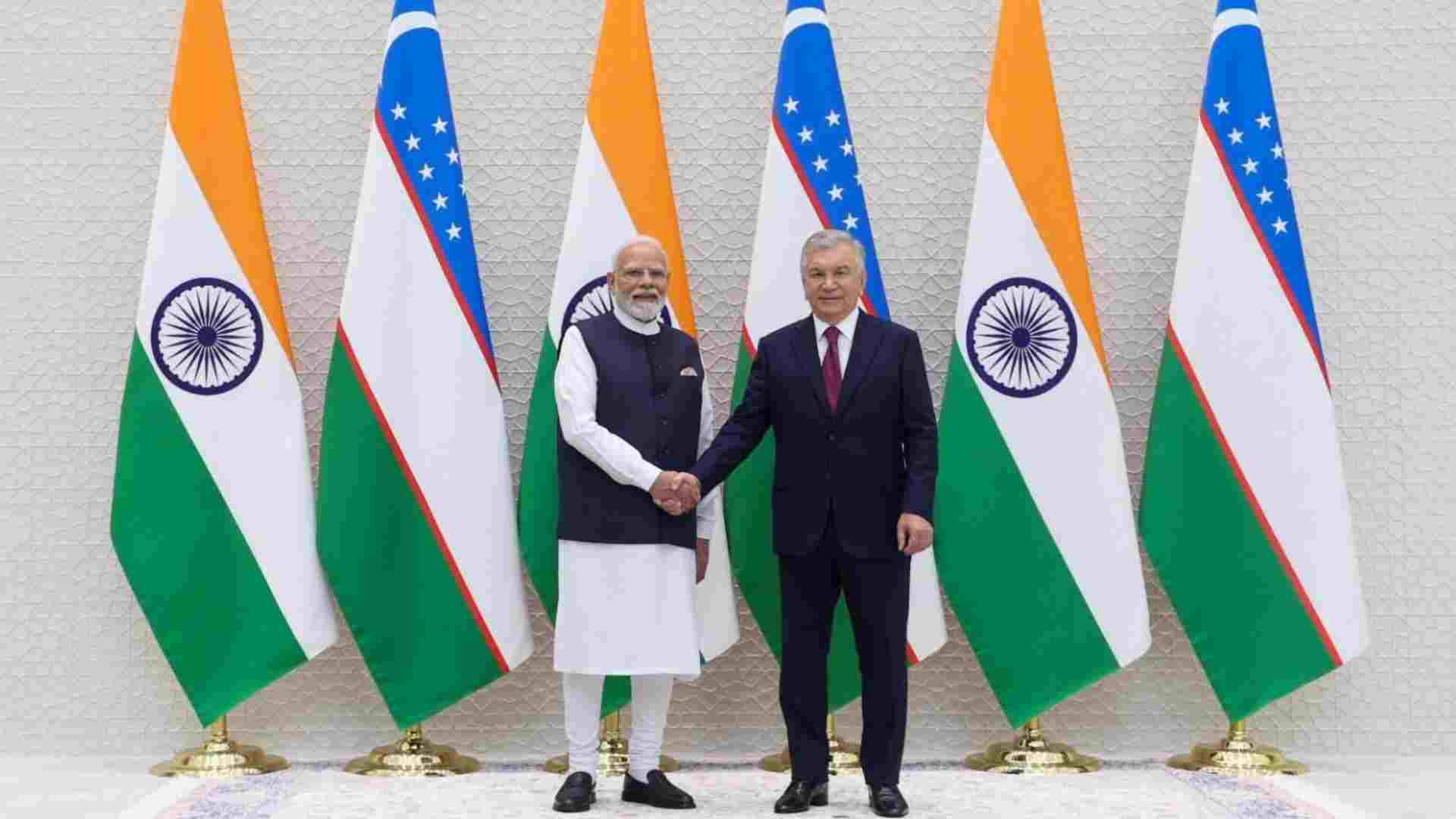

India and Uzbekistan have upgraded their bilateral relationship to a Comprehensive Strategic Partnership, marking a major step in their growing cooperation across several sectors.
The decision was announced on Sunday after Prime Minister Narendra Modi held talks with Uzbek President Shavkat Mirziyoyev in Tashkent. The two countries also marked the 15th anniversary of their strategic partnership.
During the discussions, both sides agreed to expand economic cooperation, improve connectivity and deepen collaboration in areas such as defence, energy, technology, critical minerals and space.
The two countries have also set an ambitious target of taking their annual bilateral trade to $5 billion by 2030, compared with the current level of more than $1 billion.
"Uzbekistan is at the heart of Central Asia and is at the heart of India's engagement in the region," PM Modi said. "A stronger India-Uzbekistan partnership will be a powerful force for peace, progress and prosperity in Central Asia," he added.
Key outcomes from today’s talks with President Shavkat Mirziyoyev in Tashkent include:
— Narendra Modi (@narendramodi) August 30, 2026
Elevation of India-Uzbekistan relations to a Comprehensive Strategic Partnership.
Boost trade to over 5 billion dollars by 2030.
Increase cooperation in infrastructure, DPI, AI, critical… pic.twitter.com/aSpqLm7iNt
India Uzbekistan Set $5 Billion Trade Target
Trade and investment emerged as major areas of discussion between the two leaders. India and Uzbekistan agreed to increase annual bilateral trade to more than $5 billion by 2030. At present, trade between the two countries is above $1 billion. PM Modi said both nations would work in a structured manner to address issues related to market access, connectivity, banking and payment systems.
The talks also covered a wide range of economic and strategic areas. These included infrastructure, digital public infrastructure, including UPI, information technology, artificial intelligence, critical minerals, energy, space and pharmaceuticals. The two sides also discussed cooperation in defence and security, education and agriculture.
Long Term Uranium Supply Agreement
One of the major outcomes of the talks was an agreement to work towards a long-term arrangement for uranium supplies from Uzbekistan to India. The move comes under the broader cooperation between the two countries in the field of civil nuclear energy.
MEA Secretary (West) Sibi George said that the discussions on uranium supplies were positive and that both countries were close to finalising an agreement.
“Positive discussions have happened on a long-term arrangement for the supply of uranium to India. We are close to signing an agreement very shortly. The level of bilateral ties between the two countries has been raised to a Comprehensive Strategic Partnership, which, as I mentioned, includes a Foreign Minister-level Coordination Group and raising the level of the Joint Commission Meeting, or the Intergovernmental Commission, from the Secretary level to the Ministerial level,” George noted.
"A Business Summit will be held to boost economic ties, and both sides will work on a long-term arrangement for the supply of Uranium. Both sides also set a target of bilateral trade of $5 billion by 2030. That is in the next three years," he added.
The proposed uranium arrangement could strengthen India's efforts to secure reliable nuclear fuel supplies while giving Uzbekistan a long-term partner for its uranium exports.
Defence Cooperation to Get Stronger
Defence and security cooperation also featured prominently in the discussions. India and Uzbekistan agreed to encourage direct links between their defence industries. The two sides will explore opportunities for the co-development and co-production of military equipment.
PM Modi said the close defence relationship between the two countries reflected their mutual trust. "The close defence and security cooperation between our two countries reflects our deep mutual trust. In the future, we will promote direct linkages, co-production, and co-development between our defence industries," PM Modi said.
The two countries also discussed common security challenges facing the wider region. "We believe that terrorism, extremism, and separatism pose serious challenges to the entire region," he emphasised.
"Maintaining a policy of zero tolerance against these threats has been, and will continue to be, our shared resolve," the prime minister added.
New Foreign Ministers Level Coordination Mechanism
The elevation of bilateral ties to a Comprehensive Strategic Partnership will also bring changes to the existing institutional framework.
The two countries will establish a Coordination Council at the foreign ministers' level. The new mechanism will help guide cooperation across different sectors and ensure closer coordination between the two governments.
"We will establish a Coordination Council at the level of foreign ministers to provide direction to all aspects of our cooperation through close coordination," PM Modi also said.
The existing Joint Commission, or Intergovernmental Commission, will also be upgraded. It will move from the secretary level to the ministerial level, giving greater political weight to discussions on bilateral cooperation.
Business Summit Planned to Boost Investment
India and Uzbekistan will also organise a bilateral business summit to bring together leading companies and industry representatives from both countries.
"Both sides will jointly organise a business summit featuring business leaders from both nations," he continued.
The summit is expected to provide a platform for businesses to explore investment opportunities and expand commercial ties.
Areas such as infrastructure, technology, energy, critical minerals and pharmaceuticals could offer significant opportunities for greater private-sector cooperation.
Modi to Attend SCO Summit in Kyrgyzstan
Prime Minister Modi arrived in Tashkent on Saturday for a two-day visit aimed at strengthening India's relationship with Uzbekistan.
Following his engagements in Tashkent, Modi is scheduled to travel to Kyrgyzstan to attend the 26th Shanghai Cooperation Organisation (SCO) summit.
His visit to Central Asia highlights India's continued focus on strengthening political, economic and strategic partnerships with countries in the region.