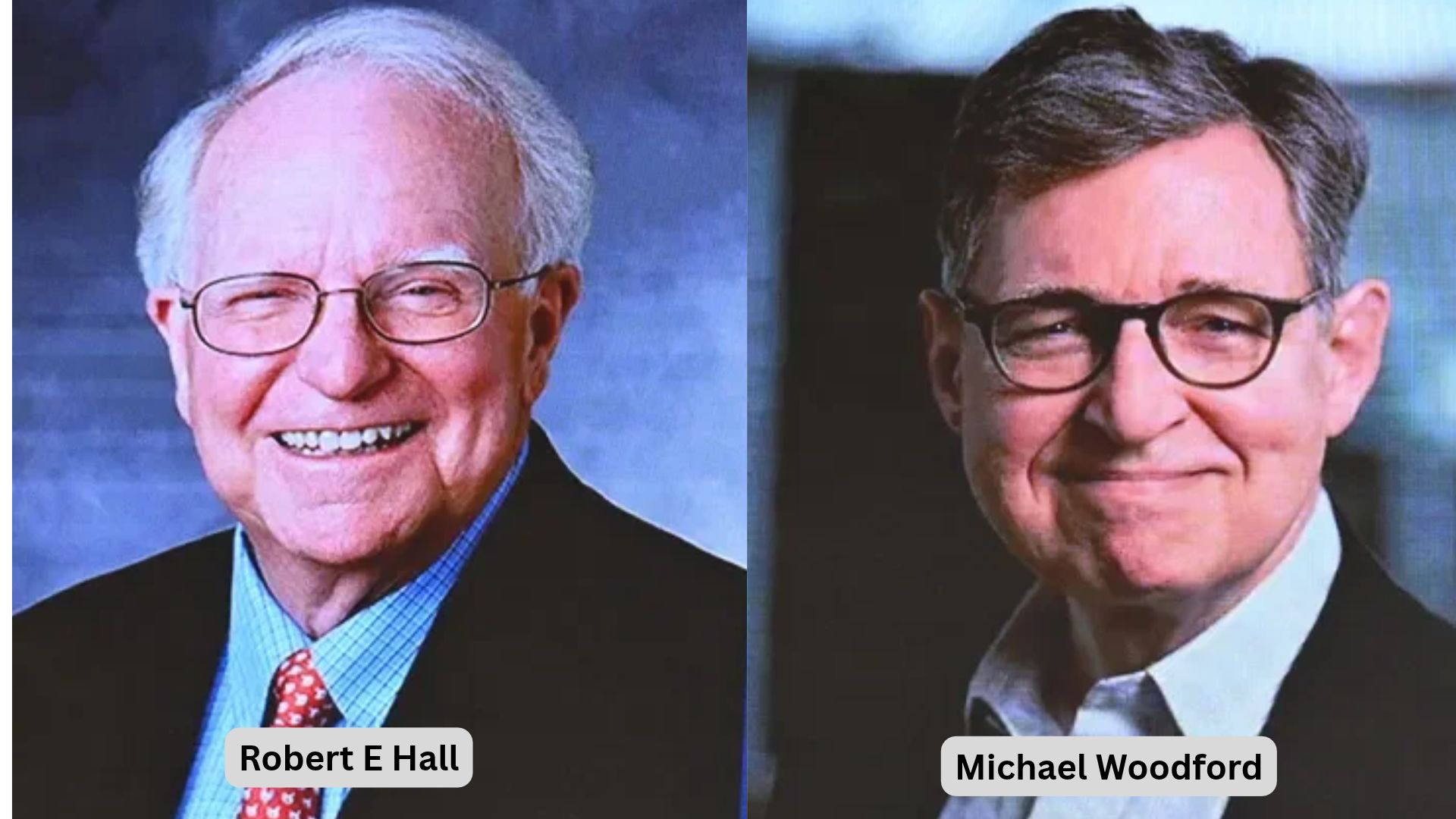
Robert E. Hall, a professor of economics at Stanford University, and Michael Woodford, the John Bates Clark Professor of Political Economy at Columbia University, have received the 2026 Sveriges Riksbank Prize in Economic Sciences in Memory of Alfred
Nobel.
The award recognises their work on the microeconomic foundations of macroeconomic stabilisation. Their research focuses on the economic principles that help explain how policies and individual economic decisions influence the wider economy and its stability.
Who Won the Nobel Economics Prize in 2025?
In 2025, the Sveriges Riksbank Prize in Economic Sciences was awarded to Joel Mokyr, Philippe Aghion and Peter Howitt for their research explaining how innovation supports long-term economic growth.
The Royal Swedish Academy of Sciences awarded half of the prize to Mokyr for identifying the conditions needed to achieve sustained economic growth through technological progress. Aghion and Howitt jointly received the other half for developing the theory of sustained growth through creative destruction.
Joel Mokyr’s Research on Technological Progress
Mokyr examined how scientific knowledge and openness to new ideas helped societies maintain technological progress over time. His research highlighted how societies can build on earlier discoveries to develop new technologies and support continued economic growth.
He also stressed the importance of understanding not only how innovations work but also why they work. This approach helps explain how scientific knowledge can encourage further discoveries and contribute to long-term development.
Philippe Aghion and Peter Howitt’s Theory of Creative Destruction
Aghion and Howitt developed the theory of creative destruction in a landmark research paper published in 1992. Their work explained how new products, technologies and businesses replace older ones, creating opportunities for innovation and economic growth.
Under this process, new ideas can improve productivity and transform industries. However, established companies must adapt to changing market conditions or risk losing their competitive position.
Their research demonstrated how technological progress can drive economic development while reshaping businesses and markets.
How Innovation Has Transformed the Global Economy
The 2025 laureates’ work explored how technological advances helped economies move beyond the prolonged stagnation that characterised much of human history.
Over the past two centuries, sustained economic growth has raised productivity, improved living standards and helped lift millions of people out of poverty. Their research highlighted the importance of innovation in maintaining this progress over the long term.
History of the Nobel Economics Prize
The award’s official name is the Sveriges Riksbank Prize in Economic Sciences in Memory of Alfred Nobel. Sweden’s central bank established the prize in 1968, and the award was first presented in 1969.
Although people commonly call it the Nobel Prize in Economics, it was not among the original five prizes established under Alfred Nobel’s will. Those original awards recognise achievements in physics, chemistry, physiology or medicine, literature and peace.
Nevertheless, the economics prize is presented alongside the other Nobel awards on December 10 each year, marking the anniversary of Nobel’s death in 1896.
In 2025, the prize carried an award amount of 11 million Swedish kronor, which the three laureates shared in recognition of their contributions to understanding technological progress and its role in long-term economic development.