
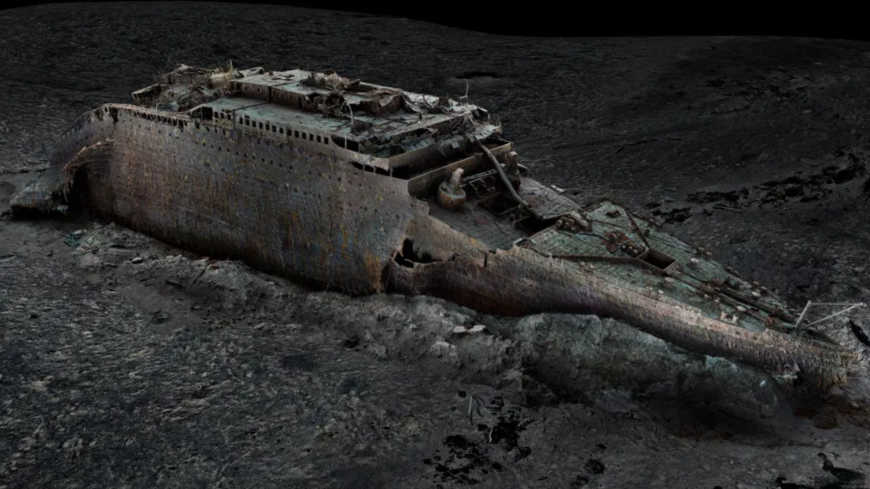

A full-sized digital scan of the Titanic has revealed striking new details about the ship’s final hours. The 3D model shows how violently the Titanic broke in two after hitting an iceberg in 1912. The disaster claimed about 1,500 lives.
The scan offers a detailed look at a boiler room, which supports survivor accounts that engineers kept working to maintain power.
A computer simulation also shows that tiny punctures—each the size of an A4 paper—played a big role in sinking the ship.
"Titanic is the last surviving eyewitness to the disaster, and she still has stories to tell," said Titanic analyst Parks Stephenson.
Digital Twin Created from 700,000 Images
National Geographic and Atlantic Productions studied the scan for a documentary titled Titanic: The Digital Resurrection.
Underwater robots captured more than 700,000 images from all angles, creating a detailed 3D “digital twin” of the wreck.
Full View of the Wreck
Because of the ship's size and the deep ocean darkness, previous explorations only showed partial views.
The scan now offers a complete view for the first time.
The bow sits upright on the seafloor, while the stern, 600 meters away, appears twisted and mangled from impact.
"It’s like a crime scene: you need to see what the evidence is, in the context of where it is," said Stephenson.
Porthole Damage Matches Eyewitness Reports
The scan also reveals a broken porthole, likely smashed by the iceberg. This fits accounts from survivors who said ice entered some cabins. Experts studied one of the ship’s boiler rooms, visible at the rear of the bow where the ship split. Survivors recalled the lights were still on as the ship sank. The scan shows some boilers are caved in, suggesting they were working when submerged. On the stern deck, an open steam valve was found, showing power was still flowing.
Joseph Bell’s Team Gave Passengers a Chance
Chief engineer Joseph Bell and his team stayed behind to feed coal into the furnaces.
"They kept the lights and the power working to the end, to give the crew time to launch the lifeboats safely with some light instead of in absolute darkness," Stephenson told the BBC.
"They held the chaos at bay as long as possible, and all of that was kind of symbolised by this open steam valve just sitting there on the stern."
Simulation Explains How Iceberg Caused Fatal Damage
A new computer model used Titanic’s blueprints, along with speed, direction, and location data, to recreate the collision.
"We used advanced numerical algorithms, computational modelling and supercomputing capabilities to reconstruct the Titanic sinking," said Professor Jeom-Kee Paik of University College London.
The ship didn’t hit the iceberg head-on. Instead, it suffered a glancing blow, creating a line of punctures.
More Compartments Flooded Than Expected
Titanic was designed to survive if four compartments flooded. However, the simulation showed six compartments were breached.
"The difference between Titanic sinking and not sinking are down to the fine margins of holes about the size of a piece of paper," said Simon Benson from the University of Newcastle.
"But the problem is that those small holes are across a long length of the ship, so the flood water comes in slowly but surely into all of those holes, and then eventually the compartments are flooded over the top and the Titanic sinks."
The damage can’t be seen in the scan, since the lower bow lies buried in ocean sediment.
Personal Items Still Rest on the Seafloor
The human loss is still visible. Belongings of passengers remain scattered on the seabed. The scan offers new insights into the tragedy, though experts say it will take years to study every part.