
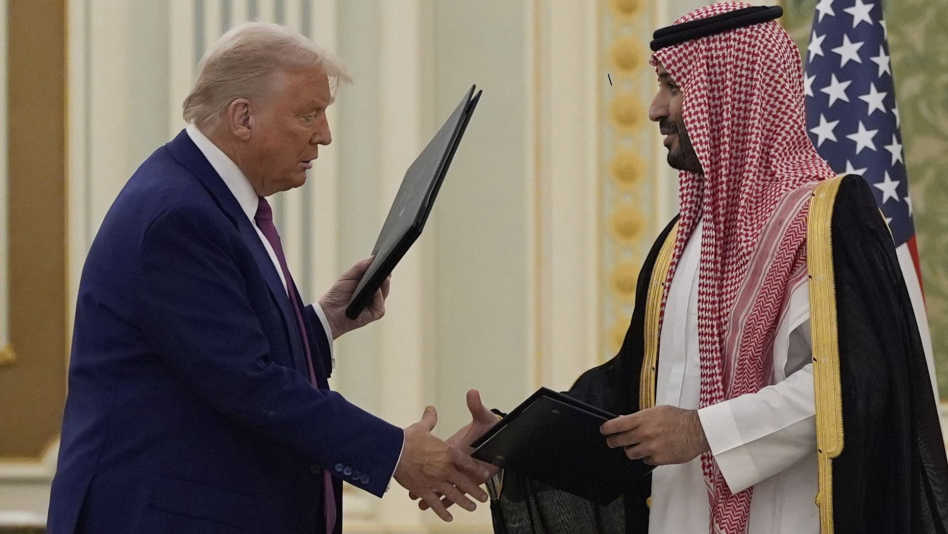

In a major boost to U.S.-Saudi relations, President Donald Trump received a $600 billion investment pledge from Saudi Arabia. Additionally, he finalized a $142 billion arms agreement, which the White House called the largest defense deal in U.S. history.
Start of Trump’s Gulf Tour
Trump began his second term’s first foreign trip in Saudi Arabia. Later this week, he will also visit the United Arab Emirates and Qatar.
As soon as Trump landed in Riyadh, he greeted the crowd with a raised fist. Saudi Crown Prince Mohammed bin Salman welcomed him warmly. Shortly after, the two leaders signed multiple agreements involving energy, defense, mining, and other industries.
Record-Breaking Arms Deal
During the visit, Trump approved a defense package worth $142 billion. According to officials, it involves contracts with over 12 American defense companies. These cover air and missile defense systems, aerospace equipment, naval security, and military communication tools.
The White House described the deal as the most significant defense cooperation in U.S. history.
Meanwhile, at a U.S.-Saudi Investment Forum, the crown prince said, “Today we hope for investment opportunities worth $600 billion, including deals worth $300 billion that were signed during this forum.” He added, “We will work in the coming months on the second phase to complete deals and raise it to $1 trillion.”
Saudi Arabia: A Longtime Buyer of U.S. Weapons
Notably, Saudi Arabia ranks among the top importers of U.S. weapons. Earlier in April, reports said that Washington was preparing another arms package worth over $100 billion for the kingdom.
During his meeting with Crown Prince Mohammed bin Salman, Trump said, “I really believe we like each other a lot.”
Additionally, sources told Reuters that Saudi Arabia wants to purchase Lockheed Martin’s F-35 fighter jets. Although discussions are ongoing, it is still unclear if these jets are included in the current deal.
Focus Shifts to Business and Investment
Moreover, Trump is traveling with several top American business leaders, including Elon Musk. He will visit Qatar on Wednesday and the UAE on Thursday.
Interestingly, Israel is not part of his itinerary. This has raised questions about the country’s current role in U.S. foreign policy. Clearly, Trump’s trip focuses more on economic investments than regional security matters.
At the investment forum, Saudi Investment Minister Khalid al-Falih stated, “While energy remains a cornerstone of our relationship, the investments and business opportunities in the kingdom have expanded and multiplied many, many times over.” He further said, “As a result … when Saudis and Americans join forces very good things happen, more often than not great things happen when those joint ventures happen.”
Strengthening the U.S.-Saudi Relationship
Trump emphasized that U.S. ties with Saudi Arabia will grow even stronger. During his tour of the investment forum, he spoke with Riyadh’s sovereign wealth fund governor Yaser al-Rumayyan, Aramco CEO Amin Nasser, and Khalid al-Falih.
According to a Wall Street Journal pool report, Trump called the crown prince a friend. He also noted that Saudi investments would create more jobs in the United States.
High-Profile Business Presence
Furthermore, many business leaders attended the forum. These included Larry Fink (CEO of BlackRock), Stephen Schwarzman (CEO of Blackstone), and U.S. Treasury Secretary Scott Bessent.
Elon Musk had a short chat with both Trump and the crown prince during a palace reception. Later, Musk and OpenAI CEO Sam Altman joined Trump and the crown prince for lunch.
Saudi Arabia Pushes Vision 2030
Crown Prince Mohammed bin Salman continues to promote his Vision 2030 plan. This economic reform program aims to reduce the kingdom’s dependence on oil. One major part of the plan is NEOM, a futuristic city the size of Belgium.
Although oil made up 62% of Saudi government revenue last year, rising costs and declining oil prices have forced the kingdom to scale back some of its ambitious plans.
A Longstanding U.S.-Saudi Partnership
For decades, the U.S. and Saudi Arabia have worked together through a simple arrangement. Saudi Arabia supplies oil, while the U.S. offers military protection.
Even though Trump skipped Israel on this tour, he still hopes to influence events there. He wants Israeli Prime Minister Benjamin Netanyahu to agree to a ceasefire in Gaza. That war has now lasted for 19 months.
Pressure Mounts on Iran
Meanwhile, Israel has carried out attacks on Hamas in Gaza and Hezbollah in Lebanon. It also targeted leaders from both Iran-backed groups. These moves have weakened Iran’s influence, giving Trump more negotiating power in the region.
Last weekend, U.S. and Iranian officials met in Oman to discuss Iran’s nuclear program. Trump has warned that if diplomacy fails, he may use military force.
At the forum, Trump stated that he wanted to give Iran a new and better path. But he added that if no agreement is reached, “Tehran will face maximum pressure.”
Efforts to Expand Arab-Israel Accords
Trump’s Middle East envoy, Steve Witkoff, recently said that more progress is expected soon on the Abraham Accords. These agreements, made during Trump’s first term, saw the UAE, Bahrain, and Morocco recognize Israel.
Trump told the forum it is his “fervent hope” that Saudi Arabia will eventually normalize ties with Israel. He added, “But you’ll do it in your own time.”
However, sources told Reuters that such progress remains unlikely. Netanyahu still refuses to end the Gaza war or accept a future Palestinian state. These positions make a Saudi-Israel deal hard to achieve right now.