
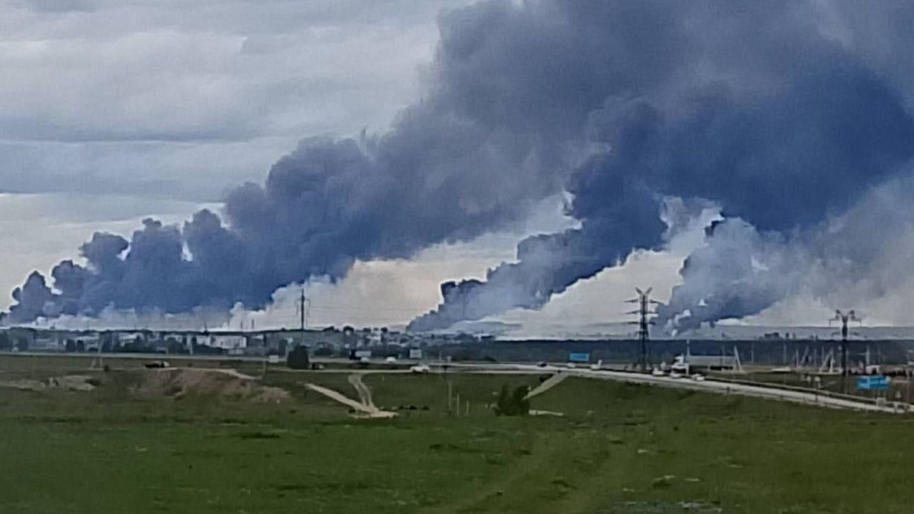

Ukraine carried out its boldest drone attack yet. Officials named the mission Operation Spider Web on June 1. After preparing for 18 months, Ukraine launched the plan. President Volodymyr Zelenskyy praised the attack as having “an absolutely brilliant outcome.” Many observers called it “Russia’s Pearl Harbor” because of its surprise and scale.
Operation Spider Web: How It Worked
Ukraine sent 117 drones into Russian territory. They smuggled these drones inside freight trucks, moving them to at least four different locations. Then, they launched the drones remotely.
The drones hit airfields in five Russian regions, stretching across five time zones. One of the targets in Irkutsk lies over 2,600 miles from the frontlines. This marks the deepest strike Ukraine has carried out in the war so far.
Ukraine Says Russian Air Force Suffered Big Losses
Ukrainian officials claimed the drones hit 41 aircraft. These included Tu-95 and Tu-22 bombers and an A-50 radar aircraft. Ukraine said these planes had been bombing its cities.
As a result, Ukraine estimates that it destroyed 34% of Russia’s strategic bombers. Officials said the damage cost $7 billion.
Ukrainian military blogger Oleksandr Kovalenko wrote on Telegram, “The damage is so serious that the Russian military-industrial complex, in its current state, is unlikely to be able to restore them in the near future.”
Russia Disputes Damage Claims
On the other hand, Russian sources gave a different version. Well-known Russian blogger Rybar reported that only 13 aircraft were damaged, including 12 bombers.
Even if Ukraine’s figures are exaggerated, experts say the financial and strategic cost for Russia is rising.
Psychological Impact Hits Russia
The attack also dealt a psychological blow to Moscow. Retired Ukrainian General Ihor Romanenko told Al Jazeera, “This is a slap on the face for Russia, for FSB, for Putin.”
Similarly, Brussels-based analyst Sven Biscop said, “At a time when Putin seems to think that he is winning on the battlefield, this demonstrates that his forces are in fact very vulnerable.”
The strike also shows Ukraine’s ability to hit Russia’s oil and gas network, which is critical to its economy.
Ukraine Gains Leverage in Peace Talks
President Zelenskyy believes this strike will help push Russia toward peace talks. He said it shows Moscow’s vulnerability.
Political analyst Volodymyr Fesenko stated, “Emotionally, psychologically and politically, the operation strengthens the positions of Ukrainian negotiators.” He added, “Ukraine won’t give up, won’t capitulate.”
Kyiv Sends a Strong Signal to Washington
Interestingly, Ukraine did not inform the U.S. before the strike. This move hints at growing mistrust between Kyiv and Washington.
Former CIA Russia analyst George Beebe told Foreign Policy, “Zelenskyy made a public statement saying that it is urgently important that the US toughen sanctions on Russia—that’s the only way that Russia will come to the negotiating table.” He believes Ukraine was also targeting the U.S. audience, not just Moscow.
What Will Russia Do Next?
So far, the Kremlin has not shifted its war strategy. However, pro-Russian commentators are demanding a strong response.
One military blogger, Roman Alekhin, posted on Telegram, “We hope that the response will be the same as the US response to the attack on Pearl Harbor, or even tougher.”