
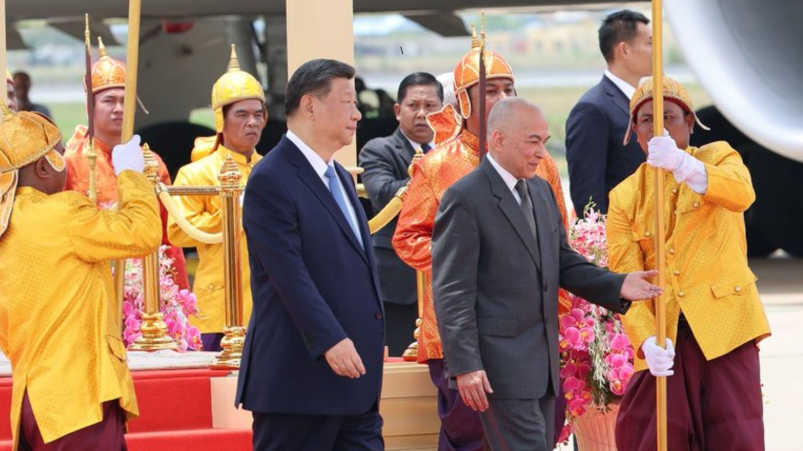

US President Donald Trump is creating tension with allies and trade partners. He is doing this by threatening to impose reciprocal tariffs. Meanwhile, Chinese President Xi Jinping is touring Southeast Asia. His visit happens during the 50th anniversary of a major U.S. defeat in the region.
Xi Arrives on a Historic Date
On April 17, 1975, the Khmer Rouge, supported by China, captured Phnom Penh. By that time, the last U.S. officials had already left Cambodia. Exactly 50 years later, Xi Jinping landed at Phnom Penh International Airport. This marked the final stop in his Southeast Asian tour.
At that time in 1975, journalist Jon Swain stayed in the capital. He was one of 22 foreign reporters who didn’t evacuate. He later described what happened. As Nikkei Asia quoted him, “Instead of delivering peace, the Khmer Rouge drove residents from Cambodia’s towns and cities at gunpoint, forcing them into the countryside to toil as peasants in what the regime called an agrarian utopia.”
The U.S. Faced a Painful Exit
Just five days earlier, U.S. Ambassador John Gunther Dean left Phnom Penh. Marines evacuated him during Operation Eagle Pull. He carried the American flag under his arm. His departure marked a humiliating U.S. defeat. According to reports, he never got over it.
Shortly after, Prince Sirik Matak met a tragic end. He had once served as Cambodia’s ambassador to China. In 1970, he helped General Lon Nol remove Prince Norodom Sihanouk with U.S. backing. On April 21, he sought safety at Hotel Le Phnom. However, the International Red Cross couldn’t protect him. As a result, he died in suffering.
Xi Concludes His Tour as Tariffs Threaten the Region
On Thursday, Xi Jinping completed his tour in Phnom Penh. At the same time, Southeast Asian economies face pressure from Trump’s trade policies. For example, Cambodia, which exports many clothes and shoes to the U.S., recently faced a 49% import tax. This was one of the world’s highest.
Although the U.S. paused most reciprocal tariffs until July, the pause did not include China. China still faces total duties of 145%.
Xi Sends a Clear Message
In a Cambodian newspaper article, Xi warned against foreign dominance. He urged leaders to resist “hegemonism” and “protectionism.” Earlier this week, he delivered the same message in Vietnam and Malaysia.
China Presents Itself as a Stable Partner
Over the past decade, China has increased its influence in Southeast Asia. It has used its economic strength to build strong relationships. Now, as Trump threatens tariffs, China offers itself as a stable and reliable partner. This message matters to Southeast Asian countries. Most of them rely on exports, and the U.S. remains one of their biggest markets.
Cambodia Faces the Harshest Tariffs
Among the affected countries, Cambodia faces the toughest U.S. tariff proposal. If the tariff pause ends, the U.S. could impose a 49% duty, plus an extra 10%. Vietnam could face a 46% tariff, while Malaysia might see a 24% duty.