
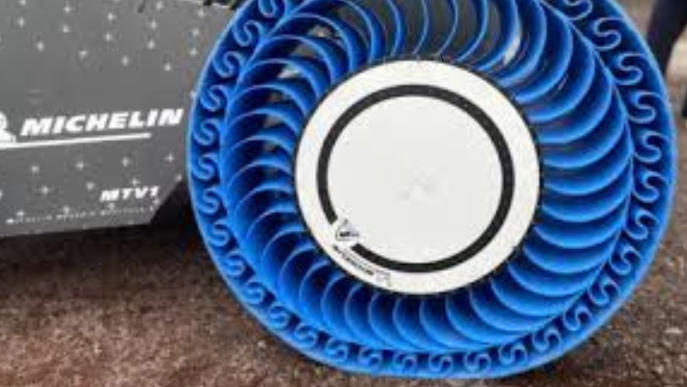

NASA is preparing for new missions to the Moon and Mars. Therefore, engineers must design tyres that can survive extreme space conditions for years. These tyres need to be strong, flexible, and durable.
Punctures Are Not Allowed
Tyres cannot get punctured in space. "One thing you cannot have is a puncture," says Florent Menegaux, CEO of Michelin. In fact, NASA learned this lesson in 2012. Just one year after landing, the Curiosity rover's aluminium tyres got torn and punctured.
Artemis Plans Longer Trips
NASA's Artemis missions aim to land astronauts on the Moon again by 2027. Moreover, Artemis V, planned for 2030, will send a rover to explore the Moon’s south pole. Unlike the Apollo missions, this rover will cover much greater distances. Between 1969 and 1972, Apollo rovers only travelled up to 40 km. Now, the target is 10,000 km in 10 years.
"We're not talking about short, week-long durations, we're talking about decades of utilisation," says Dr Santo Padula from NASA.
Harsh Temperatures Are a Big Challenge
Another major issue is temperature. The Moon’s poles can drop below -230°C. That is close to absolute zero, where atoms nearly stop moving. As a result, tyres struggle to bend and return to their shape. "Without atom motion you have a hard time having the material be able to deform and return," Dr Padula explains.
Consequently, tyres must flex over rocks and quickly bounce back. Otherwise, they become deformed, lose efficiency, and waste energy.
New Rovers Will Carry More Weight
Future rovers will carry heavier payloads. They will support science labs and mobile habitats. Furthermore, Mars missions will be even harder. Gravity on Mars is twice as strong as on the Moon. So, tyres must be even stronger.
During the Apollo era, NASA used piano wire mesh tyres. However, those tyres only worked for short trips. Rubber will not work now because it cracks or turns brittle in space.
Engineers Are Using Stronger Materials
Therefore, engineers are turning to metals and plastics. "In general, metallic or carbon fibre-based materials are used for these wheels," says Pietro Baglion from ESA.
One promising material is nitinol, made of nickel and titanium. It bends like rubber and returns to its shape. “Fuse these and it makes a rubber-acting metal,” says Earl Patrick Cole, CEO of The Smart Tire Company.
According to Dr Padula, nitinol is “revolutionary.” It stores and releases energy when it changes shape. In the future, it could even help with heating and cooling systems.
However, Michelin believes high-performance plastic may work better for long Moon missions.
Nature Inspires New Designs
Meanwhile, Bridgestone took inspiration from nature. Camels have soft feet that spread weight over sand. So, Bridgestone created a similar tyre. It has felt-like tread and flexible metal spokes. This spreads the rover's weight and prevents it from getting stuck in lunar dust.
Companies Are Testing Tyres on Earth
Currently, companies are testing their designs on Earth. Michelin is using a volcano in Clermont-Ferrand, France, because the soil is similar to Moon dust. Likewise, Bridgestone is testing in Japan’s Tottori Sand Dunes.
Both companies are presenting their tyre technology to NASA this May. After reviewing them, NASA will decide later this year. It may choose one or even combine ideas from several designs.
Europe May Build Its Own Rover
At the same time, ESA is exploring whether Europe should build its own rover. Sylvain Barthet from Michelin shared this possibility.
Space Tyres Could Help on Earth
Interestingly, this space technology may benefit Earth too. Earl Patrick Cole worked with NASA to bring the tyre tech to the market. His company will soon launch nitinol bike tyres. Although they cost $150, they last much longer than regular ones.
Additionally, he plans to build motorbike tyres for rough terrains. But his biggest dream remains space. “So, I can tell my kids, look up there on the Moon,” he says. “Daddy’s tyres are up there.”