
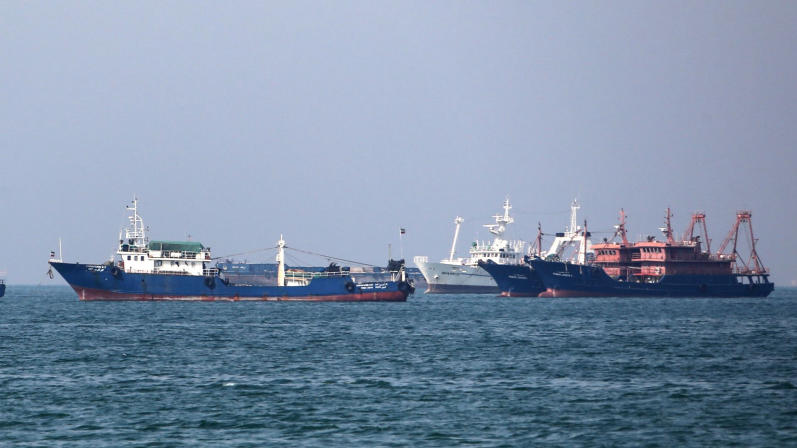

Ships sailing close to the Strait of Hormuz have started broadcasting unexpected messages about their nationality. This strange pattern aims to protect them from possible attacks as tensions remain high, despite the ceasefire between Iran and Israel, according to a Reuters report that cites data from Windward, a maritime risk analytics firm.
Change in Behavior After Conflict Erupts
This new trend began earlier this month after fighting broke out between Iran and Israel. The conflict even led to US airstrikes on Iranian nuclear sites.
Although US President Donald Trump helped broker a ceasefire after 12 days of fighting, security threats at sea haven’t gone away.
Experts Warn of Ongoing Risk
The Joint Maritime Information Center (JMIC) confirmed that the risk to commercial ships in the area remains high.
“The perception among shipowners is that due to the convoluted nature of shipping it’s hard to know or ascertain clearly a chain of ownership to nationalities which may be under higher threat in shipping, namely the UK, US and Israel,” said Ami Daniel, CEO of Windward, in a quote to Reuters.
Dozens of Ships Transmit Warning Messages
Between June 12 and 24, at least 55 ships sent out 101 unusual messages while passing through the Gulf and Red Sea, according to Windward.
These messages included terms like “China owned” or “Russian crude”. Ships used these labels to signal links to countries less likely to be targeted, compared to Western nations like the US, UK, or Israel.
Ceasefire Triggers Traffic Surge
The number of ships moving through the region jumped by 30% on June 24, just a day after the ceasefire announcement, Reuters reported, citing JMIC.
This spike reflects a temporary sense of safety—but not a complete return to normal.
Why the Strait of Hormuz Matters
The Strait of Hormuz is one of the world’s most important energy routes. Around 20% of global oil and fuel moves through these narrow waters.
Normally, ships in this region send out standard location messages like “For Orders”, or in dangerous areas, phrases like “Armed Guards on Board” to scare off pirates or threats.
Unusual Messages Now Widespread
But now, ships are using different kinds of signals. According to Ami Daniel, strange messages grew rapidly after June 12. Before that, such tactics were mostly seen in the Red Sea, where Houthi rebels targeted vessels after the Israel-Gaza war began.
“I’ve never seen it in the Persian Gulf,” Daniel told Reuters.
Real-Time Examples of Signals at Sea
Several recent ship transmissions show how vessels are trying to stay safe:
-
A Panama-flagged container ship, Yuan Xiang Fa Zhan, sailing to Pakistan, broadcasted: “PKKHI all Chinese” while crossing the Strait of Hormuz.
-
A China-flagged supertanker, Yuan Yang Hu, carried crude oil from Saudi Arabia to China. It sent out “Chinese ship” as it passed through the strait. Once it exited, the message changed to “CN NBG,” referring to China’s Port of Ningbo-Zhoushan.
-
In the Red Sea, the Singapore-flagged ship Kota Cabar sent a message saying: “Vsl no link Israel” to avoid being mistaken as an Israeli-linked vessel.
GNSS Disruptions Pose New Risks
The Joint Maritime Information Center also issued a warning about GNSS interference in the area. The Global Navigation Satellite System helps ships track their route.
However, electronic jamming or signal interference can cause ships to drift off course, leading to accidents, collisions, or grounding.