
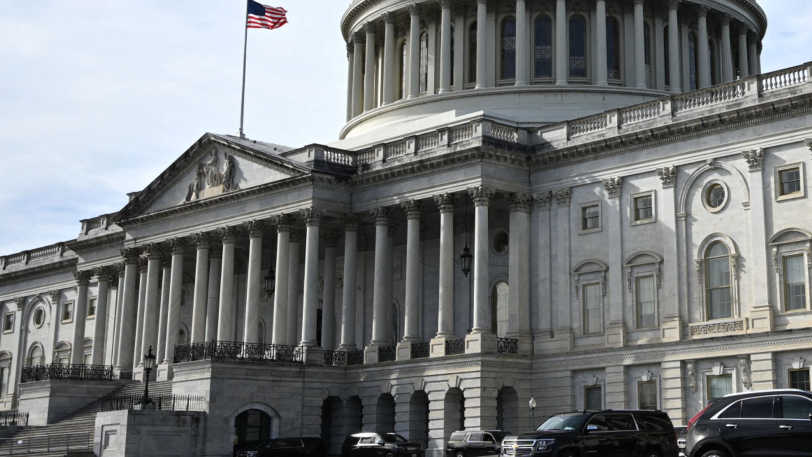

The US Senate voted Sunday night to move forward on a compromise bill to end the 40-day government shutdown. A group of moderate Democrats agreed to support the deal even without a promise to extend health care subsidies. Their decision angered many party members who wanted to keep fighting.
Three former governors — Senators Jeanne Shaheen and Maggie Hassan of New Hampshire, and Independent Senator Angus King of Maine — broke the deadlock. They voted to advance three bipartisan spending bills and extend government funding until late January. In return, they secured a mid-December vote on extending health care tax credits.
Senate Majority Leader John Thune supported the deal. “The time to act is now,” he said before calling for an immediate vote.
Crucial Vote Delayed Briefly
As the roll call neared its end, enough Democrats had voted yes to move forward. But the vote paused when Texas Senator John Cornyn had not yet arrived to cast the 60th and deciding vote. Republican leaders kept the vote open until he reached the chamber.
If the deal advances, it will also reverse the mass firings of federal workers ordered by the Trump administration and guarantee back pay.
Final passage could still take days if Democrats delay it. The plan does not include a guarantee to extend Affordable Care Act subsidies, a major Democratic demand.
Schumer and Progressives Say No
Senate Democratic leader Chuck Schumer voted no after a two-hour meeting with his caucus. He said he could not “in good faith” support the plan. “America is in the midst of a Republican-made health care crisis,” Schumer said. He warned that Americans would “suffer immensely” if subsidies were not renewed.
Independent Senator Bernie Sanders called the deal a “horrific mistake.” Senator Chris Murphy said voters had told Democrats to “hold firm.” He added, “People know the government shutdown hurts. But people know that Americans will die when millions cannot afford health insurance next year.”
Some Democrats Support the Deal
Some Democrats still backed the compromise. Virginia Senator Tim Kaine, whose state employs millions of federal workers, voted yes. “To earn my vote, we need to be on a path toward fixing Republicans’ health care mess and to protect the federal workforce,” Kaine said.
Senators Dick Durbin, John Fetterman, Catherine Cortez Masto, and Jacky Rosen also supported the deal. But others — including Mark Warner, Chris Van Hollen, and Angela Alsobrooks — opposed it.
Bipartisan Spending Bills Included
The deal includes three bipartisan bills to fund food aid, veterans’ programs, and the legislative branch. Other funding will run until late January, giving Congress more time to finish budget talks.
The bill freezes congressional pay raises but adds $203.5 million for security after rising threats. It also includes a measure from Senator Mitch McConnell to limit the sale of certain hemp-based products.
The plan restores federal workers who were laid off, repays states that kept programs running during the shutdown, and ensures back pay once the government reopens.
House Democrats Condemn the Deal
House Democrats quickly criticized the Senate. Representative Greg Casar, head of the Congressional Progressive Caucus, called it a “betrayal.” He said, “Accepting nothing but a pinky promise from Republicans isn’t a compromise — it’s capitulation.”
Representative Angie Craig wrote, “If people believe this is a ‘deal,’ I have a bridge to sell you.”
House Democratic leader Hakeem Jeffries blamed Republicans. “Donald Trump and the Republican Party own the toxic mess they have created in our country and the American people know it,” he said.
Health Care Fight Still Ahead
It is unclear if the parties will reach an agreement on health care subsidies before the promised December vote. House Speaker Mike Johnson has not agreed to bring the issue up. Some Republicans are open to extending COVID-era tax credits but want stricter limits on who qualifies.
Others, including Donald Trump, continue to attack the Affordable Care Act. On Sunday, Trump posted, “THE WORST HEALTHCARE FOR THE HIGHEST PRICE.”
Shutdown Impact Deepens
The shutdown’s effects are worsening. On Sunday, US airlines canceled over 2,000 flights and delayed 7,000 more — the worst since the shutdown began. Treasury Secretary Sean Duffy warned on CNN that air travel could be “reduced to a trickle” before Thanksgiving if the government stays closed.
Food aid delays are growing too. Millions of Americans are waiting for Supplemental Nutrition Assistance Program benefits. In Washington, D.C., where many federal workers remain unpaid, the Capital Area Food Bank said it will serve eight million more meals than planned — a 20% increase — to help families during the holidays.