
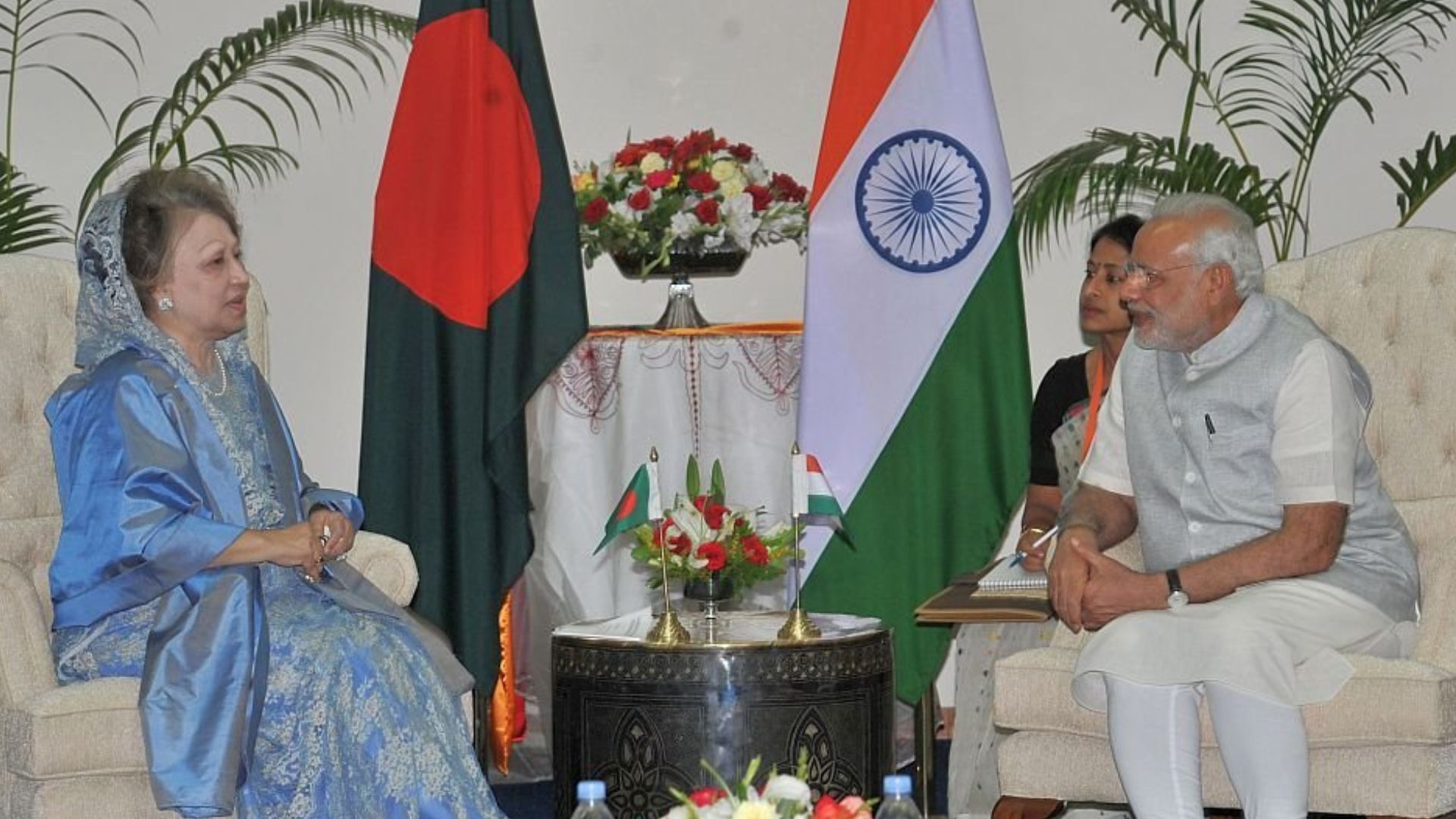

After the passing of Bangladesh’s former prime minister Khaleda Zia at the age of 80, Prime Minister Narendra Modi expressed deep sorrow and extended condolences to her son, Tarique Rahman. Khaleda Zia died in Dhaka on December 31.
Tarique Rahman, who is the acting chief of the Bangladesh Nationalist Party (BNP), recently returned to Bangladesh after spending 17 years in self-imposed exile. PM Modi shared his message of sympathy through a letter addressed to Rahman, according to news agency ANI.
Letter Delivered by External Affairs Minister
PM Modi’s letter was personally handed over to Tarique Rahman by India’s External Affairs Minister S Jaishankar. Jaishankar was in Dhaka on Wednesday to attend Khaleda Zia’s funeral and represent India at the ceremony.
In his message, PM Modi said his thoughts were with both the Zia family and the people of Bangladesh during this time of loss.
“Leader of Rare Resolve and Conviction”
In the letter, PM Modi described Khaleda Zia as a leader of “rare resolve and conviction”. He wrote,
“I was deeply saddened to learn of the passing away of your mother, Her Excellency Begum Khaleda Zia, former Prime Minister of Bangladesh and Chairperson of the Bangladesh Nationalist Party. Please accept my heartfelt condolences on this profound personal loss. May her soul rest in eternal peace.”
PM Modi also recalled his first meeting with Khaleda Zia in Dhaka in 2015. He noted her major role in Bangladesh’s development and her efforts to improve ties between India and Bangladesh.
He referred to her contributions to the country and to “strengthening India-Bangladesh relations”.
Legacy That Will Endure
PM Modi said Khaleda Zia’s death has created a major void, but her ideas and values will continue to inspire future generations.
“While her passing leaves an irreplaceable void, her vision and legacy will endure. I am confident that her ideals will be carried forward under your able leadership of the Bangladesh Nationalist Party, and will continue to serve as a guiding light to ensure a new beginning and the enrichment of the deep and historic partnership between India and Bangladesh,” the letter read, as quoted by ANI.
He also expressed solidarity with the people of Bangladesh during the period of national mourning.
“At this moment of national mourning, my thoughts are also with the people of Bangladesh, who have shown remarkable strength and dignity throughout their history,” the letter added.
Prayers for Strength and Unity
PM Modi further said that Bangladesh would continue to move forward guided by shared values, democratic traditions, and national unity. He ended his message by wishing strength to Tarique Rahman and his family.
“Please accept my heartfelt condolences once again. I pray to the Almighty to grant you and your family the strength and fortitude to overcome this difficult time. I also extend my best wishes to you in your future endeavours,” he said.
Jaishankar Attends Funeral in Dhaka
External Affairs Minister S Jaishankar arrived in Dhaka on a special flight on Wednesday morning. The Indian High Commissioner to Bangladesh received him at the airport.
Jaishankar met Tarique Rahman and conveyed India’s deepest sympathies over the death of Khaleda Zia. He later shared details of the meeting on X.
“On arrival in Dhaka, met with Mr Tarique Rahman @trahmanbnp, Acting Chairman of BNP and son of former PM of Bangladesh Begum Khaleda Zia,” he wrote.
Focus on Bilateral Relations
Jaishankar also spoke about Khaleda Zia’s lasting influence on India-Bangladesh ties.
“Expressed confidence that Begum Khaleda Zia's vision and values will guide the development of our partnership,” he added.
His visit came at a sensitive time, as relations between India and Bangladesh have faced strain following the killing of a Hindu man, Dipu Chandra Das, in Mymensingh. India has raised concerns over the safety of minorities in Bangladesh.
Looking Ahead to a New Chapter
As his Dhaka visit concluded, Jaishankar again took to X and said he looked forward to opening a new chapter in bilateral ties. He said the future relationship would be based on shared interests, pragmatism, and mutual interdependence, themes he said he had “briefly discussed” with Tarique Rahman.