
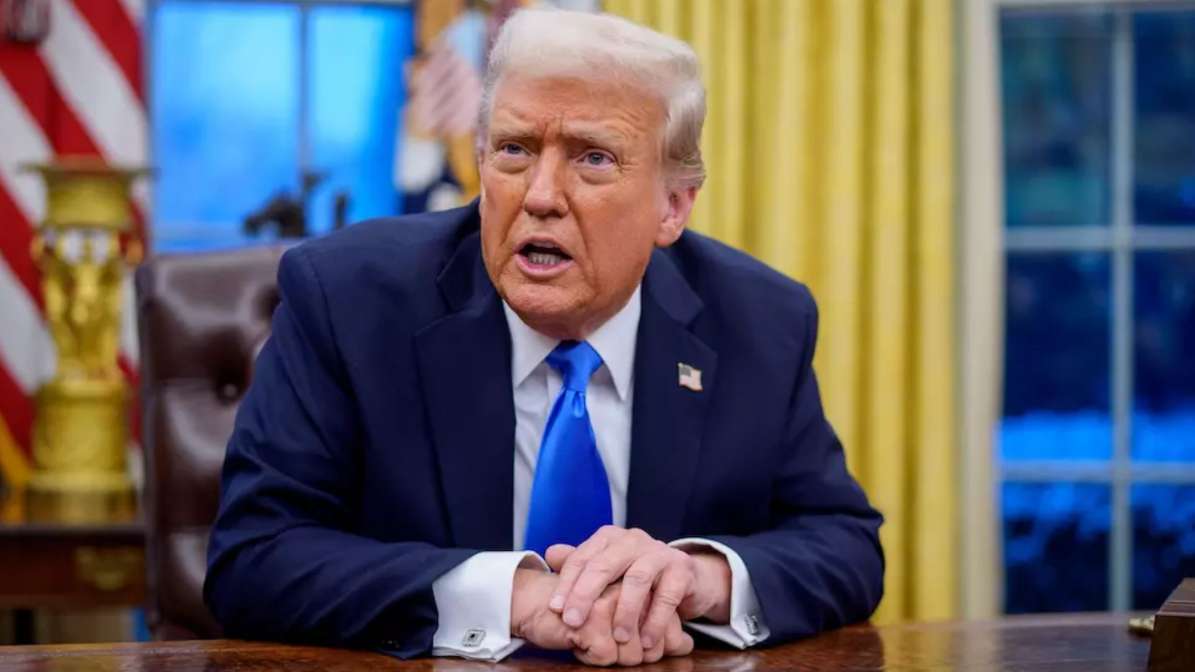

The United States has taken a major step against Iran after ceasefire talks failed in Islamabad. US President Donald Trump said the US Navy will soon begin blocking ships that enter or leave the Strait of Hormuz.
Earlier, US and Iranian officials held 21 hours of direct talks. However, they could not reach an agreement. This has put the fragile two-week ceasefire at risk.
The United States Central Command (CENTCOM) announced that the blockade will begin on Monday at 10 am EDT (5:30 pm in Iran).
Details of the Blockade Plan
CENTCOM said the blockade will be applied fairly to ships from all countries. However, vessels moving between non-Iranian ports will still be allowed to pass through the Strait of Hormuz.
A US official explained that the move is meant to show that Iran’s influence is limited as talks stall. The ongoing conflict has now entered its seventh week. It has already caused thousands of deaths and disturbed global markets.
Shipping Activity Comes to a Halt
Shipping in the Strait of Hormuz was quickly affected after the announcement. Lloyd's List Intelligence reported that “all traffic” through the strait stopped soon after Trump’s statement.
According to Associated Press (AP), two ships that were leaving the strait turned back. This disruption came just as shipping activity had started to recover following a brief pause in fighting.
Iran Claims Control Over Strait
Iran responded strongly to the US move. The Islamic Revolutionary Guard Corps Navy said it has “full control” over the Strait of Hormuz. It warned that any military ships entering the area would face a “firm and forceful response.” At the same time, Iran said that commercial, non-military ships can still use the route.
Iran Blames US for Failed Talks
Iranian Foreign Minister Abbas Araghchi said his country had negotiated in “good faith” and was close to a deal. “When just inches away from ‘Islamabad MoU’, we encountered maximalism, shifting goalposts, and blockade,” he said.
“Good will begets good will. Enmity begets enmity," he added.
Meanwhile, Parliament Speaker Mohammad Bagher Qalibaf rejected Trump’s threats. He said they would not affect the Iranian people. Qalibaf described the talks as “intensive, serious and challenging.” He also said Iran had presented “strong initiatives to demonstrate Iran’s goodwill, which led to progress,” but did not give details.
US Sets Strict Conditions
A US official said Vice President JD Vance used the talks to outline key US demands.
The main goal is to ensure that Iran never develops a nuclear weapon. The US also wants Iran to stop uranium enrichment, shut down major facilities, and allow the removal of highly enriched uranium.
Other demands include ending support for groups like Hamas, Hezbollah, and the Houthis, and keeping the Strait of Hormuz open for global shipping. Iran, however, did not agree to all these conditions.
Uncertainty Over UK’s Role
Trump also claimed that the United Kingdom would send minesweepers to the region. However, Britain’s defence ministry did not confirm this. Earlier, Foreign Secretary Yvette Cooper had discussed global cooperation to remove mines from the strait once tensions ease.
Another meeting is expected later this week to discuss restoring normal shipping operations in the area.