
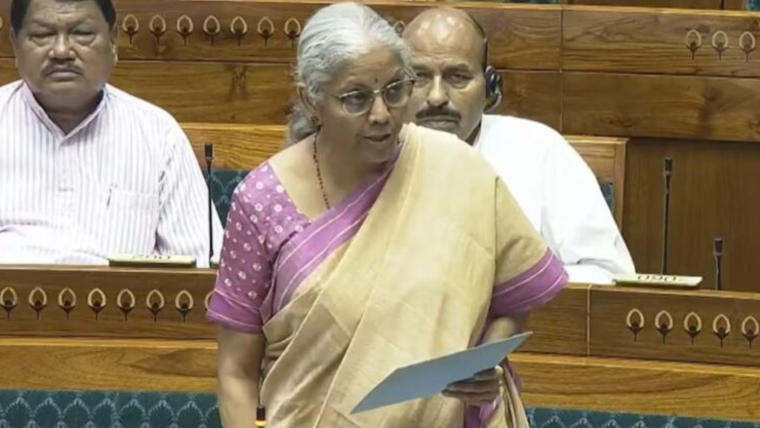

The Lok Sabha passed the Income Tax (No 2) Bill on Monday afternoon. This bill will replace the 1961 Income Tax Act with a simpler law. However, the bill passed without debate and faced loud protests from INDIA bloc MPs over Bihar’s voter list revision.
S.I.M.P.L.E Principles Guide the Bill
Finance Minister Nirmala Sitharaman introduced the bill in February. She explained that the bill follows S.I.M.P.L.E principles, which stand for:
-
Streamlined structure and language
-
Integrated and concise
-
Minimized litigation
-
Practical and transparent
-
Learn and adapt
-
Efficient tax reforms
Select Committee Shapes the Bill
After that, the bill went to a select committee led by BJP MP Baijayant Panda. The committee made 285 suggestions. Most of these were accepted, said Sitharaman. Furthermore, Panda highlighted that the bill simplifies the tax system and helps individuals and small businesses avoid legal troubles.
He added, “The 1961 Act had over 4,000 amendments and 500,000 words. It became too complex. Therefore, the new bill reduces it by nearly half.”
Key Features of the New Bill
Besides simplifying language and clarifying deductions, the bill improves cross-references between tax rules. Moreover, it clears doubts about income from house property. It also defines important terms like 'capital asset,' 'micro and small enterprises,' and 'beneficial owner.' Importantly, it aligns tax treatment for pensions and scientific research. The bill will come into effect on April 1, 2026.
Important Changes
For instance, taxpayers can claim refunds even if they file late. In addition, there will be no penalties for late filing of TDS (Tax Deducted at Source). Also, taxpayers with no tax liability can obtain 'nil-TDS certificates' in advance. Furthermore, explicit tax deductions will apply for lump sum pension payments. Finally, companies can claim deductions on inter-corporate dividends, preventing double taxation.
Property Tax Clarifications
Regarding property tax, the bill sets a standard deduction on rental income at 30%. Additionally, interest on loans taken to buy or repair property will be deductible. Moreover, if a property remains vacant, taxable rent will be the higher of expected rent or actual rent received.
Aligning MSME Definitions
The bill also aligns MSME definitions with existing rules. For example, micro enterprises invest less than ₹1 crore and earn under ₹5 crore, while small enterprises invest under ₹10 crore and earn under ₹50 crore.
Other Updates
Notably, the bill introduces a ‘tax year’ concept to replace the financial year and accounting year. This means taxpayers will pay tax on income in the same year it is earned. Additionally, the bill removes outdated sections like fringe benefit tax. It also includes tables for TDS, presumptive taxation, salaries, and bad debt deductions.
However, tax slabs will remain unchanged. Similarly, court-defined terms will stay as they are.
Additional Bill Passed
Alongside this, the Lok Sabha passed the Taxation Laws (Amendment) Bill, 2025. This bill provides tax relief to Saudi Arabia’s sovereign wealth fund and its subsidiaries investing in India.