
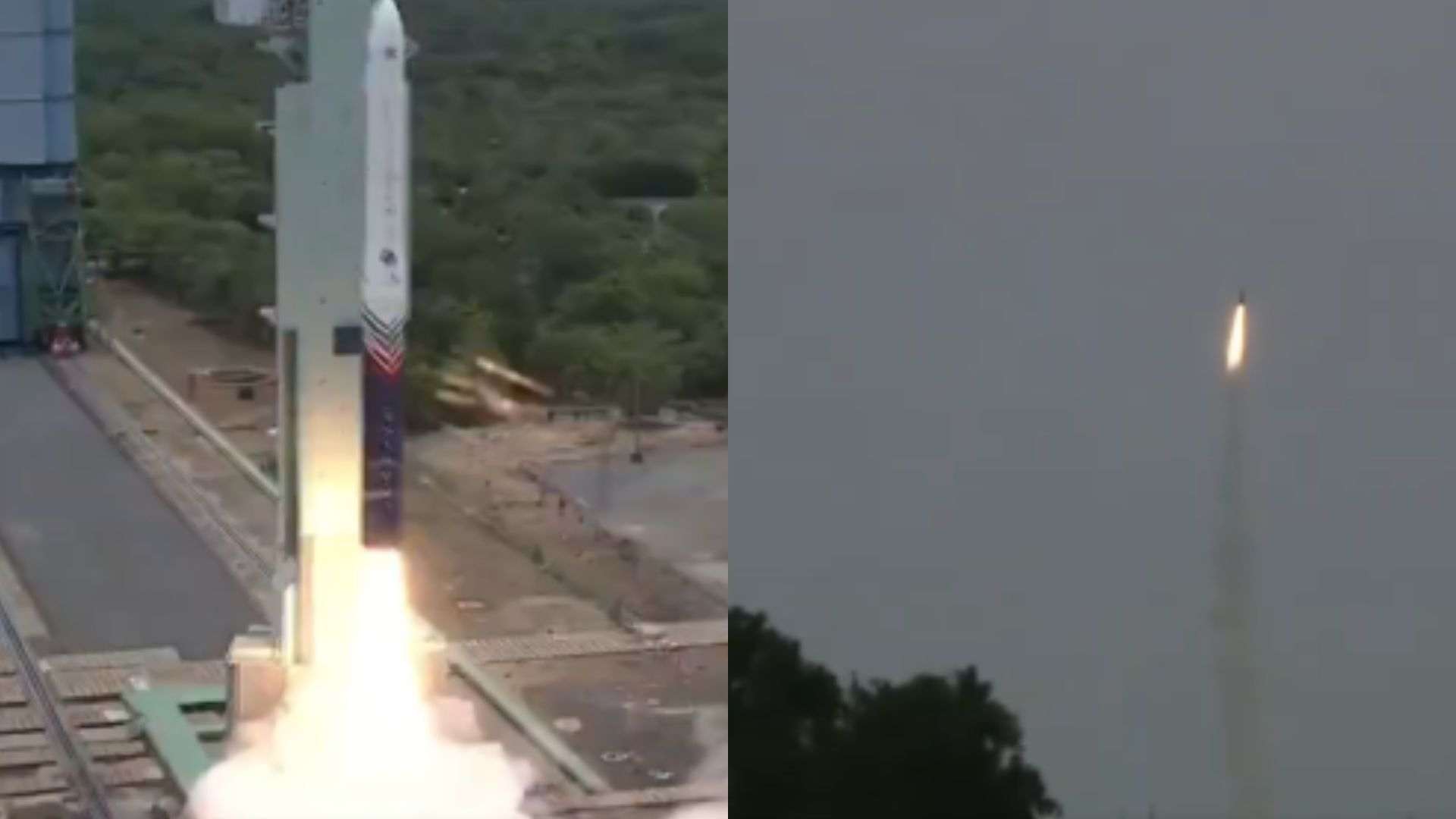

India achieved a major milestone in its space journey on Saturday as Skyroot Aerospace's Vikram-1, the country's first privately developed orbital-class rocket, successfully lifted off from the Satish Dhawan Space Centre (SDSC) in Sriharikota and placed its payloads into Low Earth Orbit (LEO).
The mission, named Mission Aagaman, marked India's entry into an exclusive group of nations with independent private orbital launch capabilities. With this achievement, India joined only the United States and China in demonstrating privately built orbital launch systems.
Mission Aagaman Achieves Historic Success
The launch took place from the First Launch Pad at the Satish Dhawan Space Centre on July 18, 2026. After a successful flight, Vikram-1 accurately injected multiple payloads into a 450-kilometre Low Earth Orbit, completing its maiden orbital mission.
The successful launch is seen as a turning point for India's private space industry and a major step toward expanding the country's commercial space capabilities.
Countdown Paused Before Liftoff
The mission experienced a brief delay during the final countdown. Thousands of spectators at Sriharikota and millions watching the live webcast saw the countdown stop just minutes before the scheduled 11:30 am IST launch.
The Indian National Space Promotion and Authorisation Centre (IN-SPACe) said the Automated Launch Sequence (ALS) detected minor navigation alignment issues. Instead of proceeding with the launch, Skyroot engineers temporarily paused the countdown to verify sensors, ground tracking systems and navigation software. After about 30 minutes of checks, engineers cleared the rocket for launch and reset the countdown. Vikram-1 finally lifted off at 12:05 pm IST.
Smooth Liftoff and Precise Flight
The 24-metre-tall rocket ignited its powerful first-stage solid motor and quickly cleared the launch tower. It followed a planned flight path over the Bay of Bengal before successfully reaching its intended orbit.
The mission demonstrated the performance of Skyroot's launch vehicle during every stage of flight.
Vikram-1 Features Advanced Indian Engineering
Named after Indian space pioneer Dr Vikram Sarabhai, Vikram-1 showcases several advanced technologies. The rocket stands nearly seven storeys tall and uses an all-carbon composite structure instead of traditional metal components. This lightweight design increases the payload capacity while reducing overall weight.
The vehicle uses three solid-fuel stages for the initial ascent, followed by a liquid-fuel Orbital Adjustment Module (OAM). The OAM allows the rocket to perform multiple engine burns, enabling it to place different satellites into separate orbits during a single mission. Skyroot also incorporated several 3D-printed engine components, helping simplify manufacturing and reduce production time.
Mission Carried Multiple Commercial Payloads
Unlike many maiden launches that carry only dummy payloads, Mission Aagaman transported several operational satellites and technology demonstrators.
Grahaa Space Nanosatellite
The satellite will test advanced Earth observation technologies, including high-speed video mapping for environmental monitoring and logistics applications.
Cosmoserve Debris Servicing System
Cosmoserve tested a robotic system designed to safely capture inactive satellites without creating additional space debris. The demonstration aims to support future space debris removal missions.
German Technology Demonstrators
German company DCubed GmbH launched its uD3PP and mD3RN deployment systems to test satellite release mechanisms under space conditions.
Skyroot SCOPE Satellite
Skyroot's own diagnostic satellite collected detailed flight data, including structural loads, vibrations and vehicle performance throughout all phases of the mission.
The information will help improve future Vikram launch vehicles.
Artistic Projects Also Reached Orbit
Mission Aagaman also carried unique cultural and artistic payloads.
Cosmic Bloom Diamond Installation
Bengaluru-based Cosmos Diamonds sent a laboratory-grown diamond artwork into orbit to demonstrate its durability under launch conditions.
Gold Sculpture Inside a Needle
Artist Ajay Kumar Mattewada created a microscopic sculpture from 18-carat gold that fit inside the eye of a sewing needle. The artwork featured tiny images of Sir C V Raman, Dr Vikram Sarabhai and Dr A P J Abdul Kalam, honouring three of India's greatest scientific figures.
Prime Minister's 'Vande Mataram' Note Sent to Space
The mission also carried a handwritten note by Prime Minister Narendra Modi containing the words "Vande Mataram." The message commemorated 150 years of India's iconic national song and symbolised the connection between the country's heritage and its technological progress.
Skyroot Aims to Become a 'Cab Service to Space'
Following the successful launch, Skyroot Aerospace Co-founder and CEO Pawan Kumar Chandana explained the company's long-term vision. He said small satellite companies often wait months or even years for rideshare opportunities on larger rockets.
Skyroot plans to solve that problem by offering dedicated launches for individual customers. “The small satellite launch market is deeply constrained on the supply side,” Chandana said.
“At the same time, the demand for services enabled by satellites in space will only continue to grow. This successful test flight is the first step towards creating a reliable, on-demand launch company for the world from India. We are moving from single, bespoke launches to an industrial cadence.”
The company hopes to provide flexible launch services that allow customers to select their own orbital destinations.
Milestone for India's Private Space Sector
The successful mission represents one of the biggest achievements for India's private space industry since the government opened the sector to private participation in 2020.
The creation of IN-SPACe allowed private companies to access ISRO's launch facilities, technical expertise and infrastructure. The reforms have helped companies like Skyroot develop launch vehicles capable of competing globally.
PM Modi Congratulates Skyroot Team
Following the successful launch, Prime Minister Narendra Modi personally congratulated the Skyroot mission team. He praised the company for proving India's private sector could successfully develop advanced orbital launch technology.
“People doubted the vision of Atmanirbhar Bharat (Self-Reliant India), claiming that private players could never match the complex systems engineering required for orbital flight, but you have proved them completely wrong,” Modi told the team.
“This achievement demonstrates that India is fully capable of becoming self-reliant in the cutting-edge commercial space sector and competing aggressively on the global stage. You fly higher, and I am with you.”
External Affairs Minister S. Jaishankar also described the mission as "truly historic" and praised India's growing private space ecosystem.
What Comes Next
Skyroot will now analyse the flight data collected during Mission Aagaman to improve future launches. Engineers will focus on refining the rocket's carbon-composite structure, enhancing automated launch systems and increasing production of rocket motors.
The success of Vikram-1 is also expected to boost India's wider private space industry, with companies such as Agnikul Cosmos and private manufacturing partnerships for ISRO's SSLV and PSLV programmes preparing for future missions.
Mission Aagaman marks the beginning of a new chapter for India's commercial space sector, positioning the country as a major player in the rapidly growing global satellite launch market.