
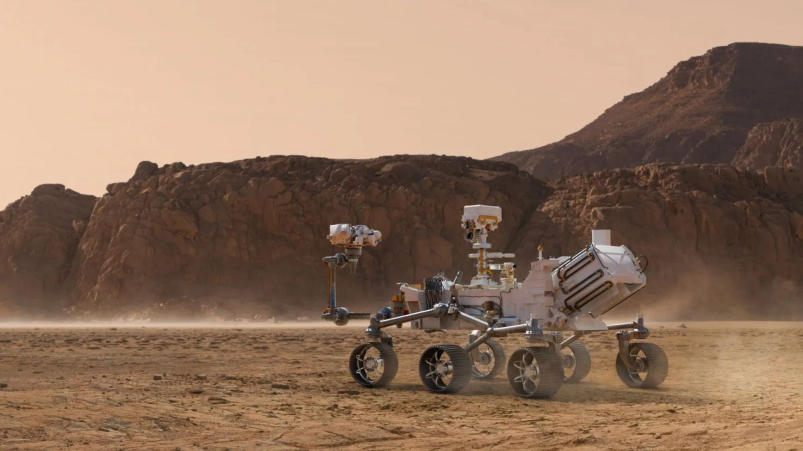

NASA’s Perseverance rover has made a major breakthrough on Mars. It discovered unusual rocks in a dry river channel that might contain signs of ancient microscopic life, scientists announced on Wednesday.
Since 2021, the rover has explored Mars in search of clues about past life. However, it cannot directly detect life. Instead, it drills into rocks and collects samples inside titanium tubes. These sealed samples must return to Earth for detailed study in high-tech laboratories.
Originally, NASA planned to bring these samples back by the early 2030s. However, as costs rose to $11 billion, the timeline slipped into the 2040s. Consequently, NASA is now looking for cheaper and faster solutions to complete the mission.
Scientists Warn Against Jumping to Conclusions
NASA’s science mission chief Nicky Fox said the discovery is an important step forward. “It certainly is not the final answer,” she explained. “But it’s the closest we’ve actually come to discovering ancient life on Mars.”
Moreover, two scientists who were not part of the research — Janice Bishop from the SETI Institute and Mario Parente from the University of Massachusetts Amherst — praised the finding. However, they cautioned that non-biological processes could also explain the unusual rock formations.
Lead researcher Joel Hurowitz of Stony Brook University echoed their concerns. “All we can say is one of the possible explanations is microbial life, but there could be other ways to make this set of features that we see,” he said.
Furthermore, he added, “It would be amazing to be able to demonstrate conclusively that these features were formed by something that was alive on another planet billions of years ago.”
Nevertheless, Hurowitz reminded everyone that natural processes can create similar patterns. “It’s a valuable lesson in all of the ways that nature can conspire to fool us,” he said.
How and Where the Sample Was Collected
Last summer, Perseverance collected this particular sample in Neretva Vallis, a river channel that once carried water into Jezero Crater. Billions of years ago, this area may have been part of a vast lake system.
The rover drilled into reddish, clay-rich mudstones in a region called the Bright Angel formation. Before drilling, it carefully scanned the site with its onboard instruments.
As a result, the team discovered organic carbon, which is a fundamental building block of life. Additionally, they found tiny specks, nicknamed “poppy seeds” and “leopard spots.” These were rich in iron phosphate and iron sulfide.
On Earth, such chemical compounds often form when microorganisms feed on organic matter.
Bishop and Parente explained, “There is no evidence of microbes on Mars today, but if any had been present on ancient Mars, they too might have reduced sulfate minerals to form sulfides in such a lake at Jezero Crater.”
Most Promising Sample Collected So Far
Hurowitz described this discovery as the most promising sign yet in the search for past life on Mars. This rock was the 25th sample collected, bringing Perseverance’s total to 30 samples so far.
Importantly, ten samples have been placed on the Martian surface as a backup, while the rest remain safely stored inside the rover.
Next Steps and Major Challenges
However, scientists cannot confirm life until they study these samples on Earth. Until then, they will rely on Earth-based simulations and experiments to explore how these features may have formed.
Because of delays and rising costs, NASA is reconsidering its strategy for returning the samples. Acting Administrator Sean Duffy said both budgets and timing will determine the final plan.
Moreover, he suggested another possibility — sending advanced instruments directly to Mars to conduct studies there. “All options are on the table,” Duffy stated.
Moving Closer to Solving a Martian Mystery
The findings, published in the journal Nature, mark a significant milestone in space exploration.
Although there is no evidence of life on Mars today, these discoveries bring scientists closer to understanding whether ancient Martian life once existed. With each sample collected, Perseverance moves humanity one step closer to answering one of the biggest questions in science — Was there ever life on Mars?