
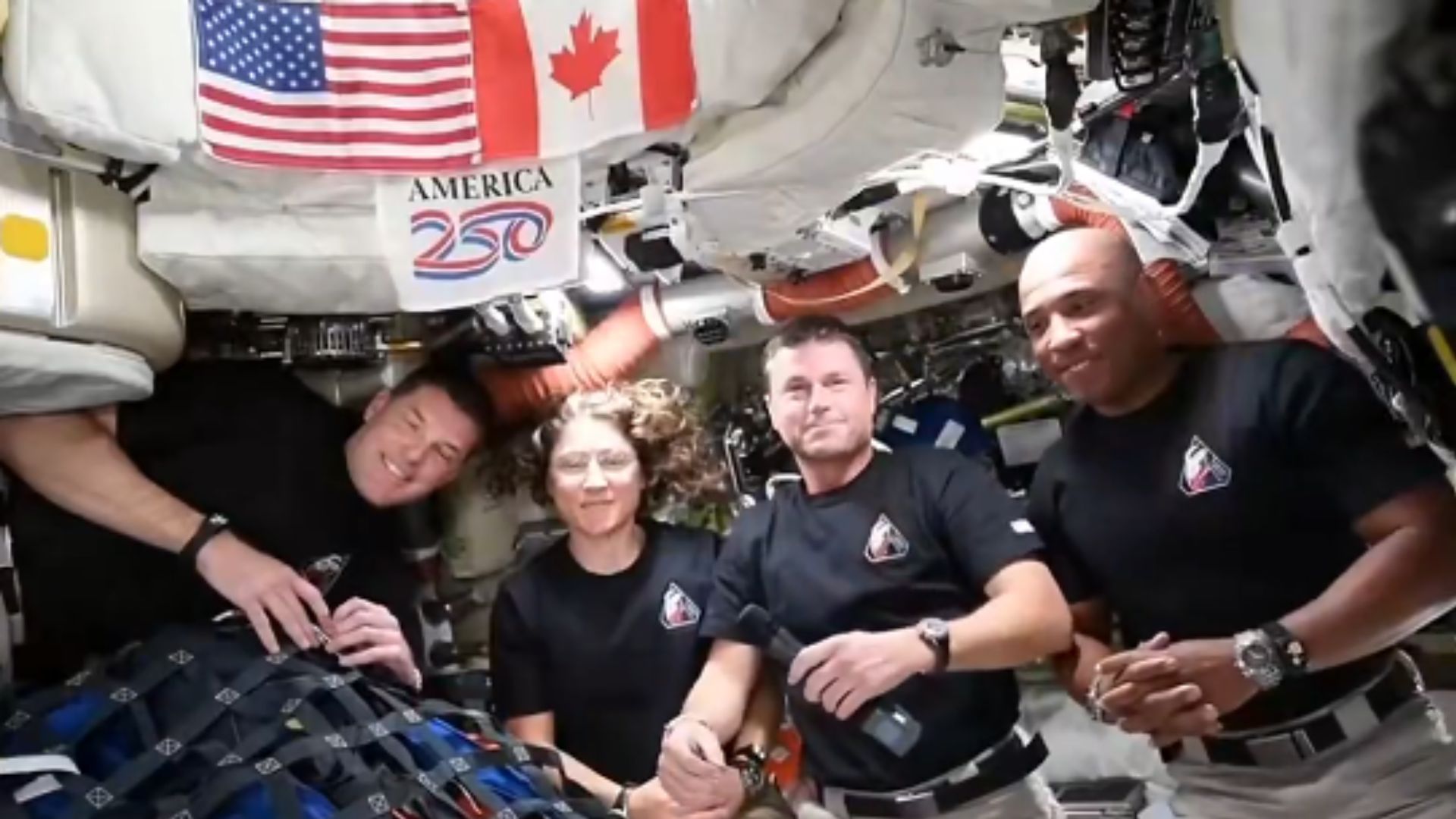

In a historic achievement, astronauts aboard Artemis II have set a new record for the greatest distance ever travelled by humans in space, surpassing a milestone that had remained unbroken for more than 50 years.
New Distance Record Surpasses Apollo 13
At 12:56 p.m. CDT on Monday, the crew reached a distance of 248,655 miles from Earth, overtaking the previous record set during the Apollo 13 mission in 1970, according to NASA.
The spacecraft is expected to go even farther, reaching a peak distance of around 252,756 miles before beginning its return journey. This will establish a new benchmark in human space exploration.
Crew and Mission Progress
The mission, which marks NASA’s first crewed flight under the Artemis programme, is currently six days into its journey. The crew includes astronauts Reid Wiseman, Victor Glover, Christina Koch, and Canadian astronaut Jeremy Hansen.
As they travel deeper into space, the astronauts are observing the Moon, taking photographs, and gathering important data to support upcoming missions.
Launch and Journey Toward the Moon
The crew launched on April 1 from Kennedy Space Center aboard NASA’s powerful Space Launch System, travelling in the Orion spacecraft. After leaving Earth’s orbit, the spacecraft began its path toward the Moon.
During the lunar flyby, Orion will pass within about 4,067 miles of the Moon’s surface. The astronauts are expected to directly observe parts of the Moon’s far side and also witness a solar eclipse when the Moon moves in front of the Sun.
Communication Blackout and Return Plan
A temporary communication blackout of about 40 minutes is expected during the flyby, as the Moon blocks signals between the spacecraft and Earth. Communication will resume once the spacecraft moves back into range, reconnecting with mission control at Johnson Space Center.
After completing the lunar flyby, Orion will continue on a free-return path back to Earth. The mission is scheduled to end with a splashdown in the Pacific Ocean near California after around 10 days in space.