
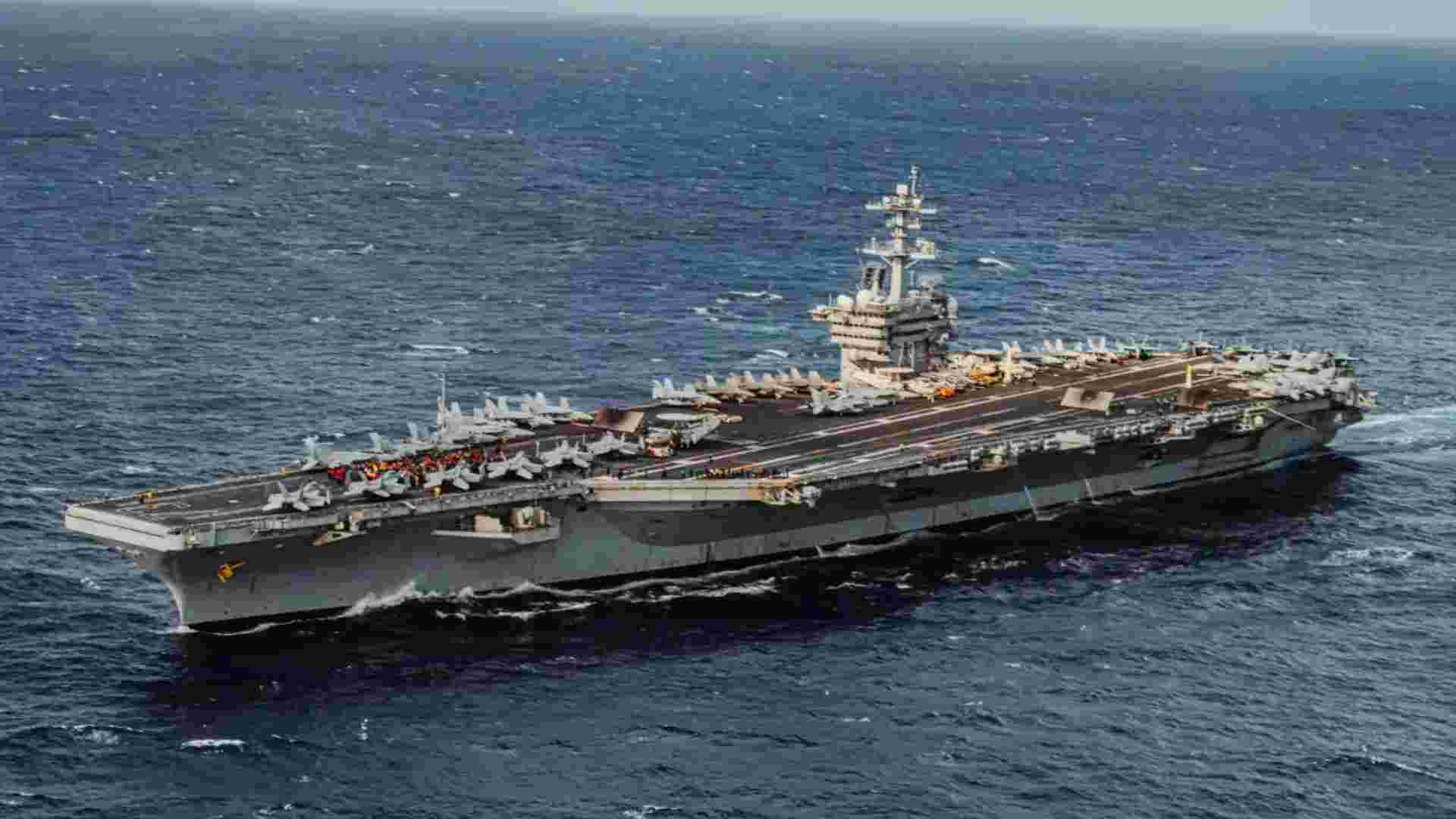

The United States is moving one of its major aircraft carriers from the western Pacific to the Middle East as the war with Iran puts growing pressure on the US Navy. The deployment will create a temporary gap in the American carrier presence in the western Pacific, where China has become increasingly assertive.
The USS George Washington is leaving the Pacific and is expected to replace the USS Abraham Lincoln in the Middle East. The move comes after the Lincoln’s deployment was extended beyond its original return date in May to support US military operations against Iran. The prolonged deployment has also created concerns about supplies and the mental health of sailors serving aboard the carrier.
The western Pacific could therefore be left without a US aircraft carrier for a period. However, the gap could be short-lived if another American carrier arrives in the region within the next few months. Analysts cited by The Associated Press say the development shows how the continuing conflict with Iran is putting additional pressure on the US Navy and limiting its ability to maintain a strong presence across multiple regions.
US Military Attention Moves From Pacific To Middle East
The carrier shift reflects the difficult strategic choices facing the Trump administration. Washington has said that the Pacific is expected to remain its most important region after the Western Hemisphere. However, the continuing war with Iran is forcing the US to redirect military resources toward the Middle East.
Greg Poling, director of the Southeast Asia Program at the Centre for Strategic and International Studies, said the US is instead “doing the exact opposite" of its previously expressed goal of pulling out of the Middle East.
The change is also creating uncertainty among American allies in the Pacific. Poling said US partners are concerned about the unpredictability of Washington’s policies.
At the same time, Beijing could benefit from the situation. Poling said China is “quite happy with US distraction, with the frustration of US allies and partners."
China Could Use The Opportunity
China considers the US military presence in the western Pacific a challenge to its regional ambitions. Beijing also sees the American military presence as an obstacle to its long-term goal of bringing Taiwan under its control.
The temporary absence of a US aircraft carrier does not mean China is preparing to invade Taiwan. However, analysts believe Beijing could use the development to demonstrate its growing military influence.
Bryan Clark, a former Navy submariner and defence analyst at the Hudson Institute, said China could use the carrier gap to send a broader message to countries across the region.
“They’re using this as part of the narrative to demonstrate to the Philippines, to Japan, to Indonesia and others that the US is not the big dog in the western Pacific anymore," Clark said.
According to Clark, Beijing wants regional countries to believe that China is becoming the dominant power while Washington may no longer be able to guarantee their security in the same way.
The issue could be particularly important for US partners such as Japan and the Philippines. Both countries have ongoing territorial disputes with China.
Beijing has recently increased its military activities in the region. China held naval exercises with Indonesia this week. It has also shown increasingly aggressive behaviour involving Japan and the Philippines.
Earlier this month, Chinese forces carried out military drills near Scarborough Shoal in the South China Sea. The area is claimed by both China and the Philippines. Last month, a Chinese guided-missile destroyer conducted a live-fire exercise near Japan’s southernmost island of Okinotori.
Washington Tries To Reassure Its Allies
The US is seeking to assure its allies that the carrier’s departure does not signal a reduction in its commitment to the western Pacific. Adm. Frank Bradley, head of the US Special Operations Command, visited Manila on Thursday. During the visit, he told Filipino officials that US special operations forces were ready to expand joint military exercises.
The increased exercises are intended to strengthen the US-Philippines alliance and demonstrate continued American military cooperation in the region. Bradley is also expected to visit Japan.
However, Evan Sankey, a policy analyst at the Cato Institute who studies US policy toward China, said aircraft carriers have an important psychological role for American allies. The presence of a carrier can provide confidence that the US is prepared to respond to a regional crisis. Its absence could therefore affect perceptions of American commitment. Sankey said the carrier’s departure “adds to the general sense that the U.S. is distracted by events in the Middle East."
Long Deployments Put Pressure On Sailors
The movement of the George Washington also highlights the growing strain on the US aircraft carrier fleet. The USS Abraham Lincoln has remained continuously at sea for more than 240 days. That has set a record for uninterrupted time at sea. Its deployment has also been extended because of the US military campaign against Iran.
Robert Farley, who teaches national security and diplomacy at the University of Kentucky, said both ships and their crews have limits when they remain deployed for extended periods. “People don’t get enough rest. It’s psychologically exhausting," Farley said. He added that a crew’s ability to perform at maximum efficiency can decline as a deployment continues for too long.
The prolonged operations also raise questions about whether the Navy had prepared for a conflict with Iran lasting this long. Clark said the current pressure shows a lack of planning for a prolonged war. He argued that the Navy could have adjusted its carrier deployment schedules if officials had expected the conflict to continue for an extended period. The US Navy operates 11 aircraft carriers and generally has two or three deployed at any given time, according to Clark.
The Navy could potentially have four carriers deployed if the USS Theodore Roosevelt leaves San Diego for the Middle East. Such a move could allow the George Washington to return to the Pacific. However, expanding deployments could create another major challenge: maintenance.
Maintenance Could Become A Bigger Problem
Aircraft carriers require regular maintenance after extended operations. Increasing the number of deployments could therefore put additional pressure on the Navy’s maintenance system.
The US Navy has only two shipyards capable of carrying out major carrier maintenance. A higher operational tempo could create a backlog at those facilities. Clark warned that the Navy could face a growing maintenance burden in the coming years.
“We’ll end up with a maintenance debt that needs to be paid for the next few years," Clark said. This could create a difficult cycle for the Navy. Longer deployments increase pressure on crews and ships, while additional maintenance requirements could reduce the number of carriers available for future missions.
Carrier Gap Gives Beijing A Strategic Opportunity
For China, the movement of the George Washington represents more than the temporary relocation of an American warship. Beijing could use the situation to strengthen its broader message that the US is becoming distracted by conflicts and commitments outside the Indo-Pacific.
The development could also encourage China to increase its military and diplomatic pressure on regional countries while Washington focuses on Iran. At the same time, the future role of large aircraft carriers is facing growing questions as modern warfare changes.
Swaine questioned how useful massive aircraft carriers will remain in a battlefield where drones and long-range missiles can threaten large naval platforms. Smaller warships and submarines can also carry out powerful strikes while potentially presenting smaller targets. Senior US Navy officials have also shown interest in expanding the use of smaller and newer platforms.
Adm. Daryl Caudle, chief of naval operations, told AP in February that military commanders should consider smaller ships and other capabilities instead of relying so heavily on large aircraft carriers.
The current carrier redeployment therefore highlights two major challenges for the US Navy. Washington must maintain enough naval power to support its operations in the Middle East while also reassuring allies and deterring China in the western Pacific. At the same time, the Navy must manage the growing demands on its ships, sailors and maintenance facilities.