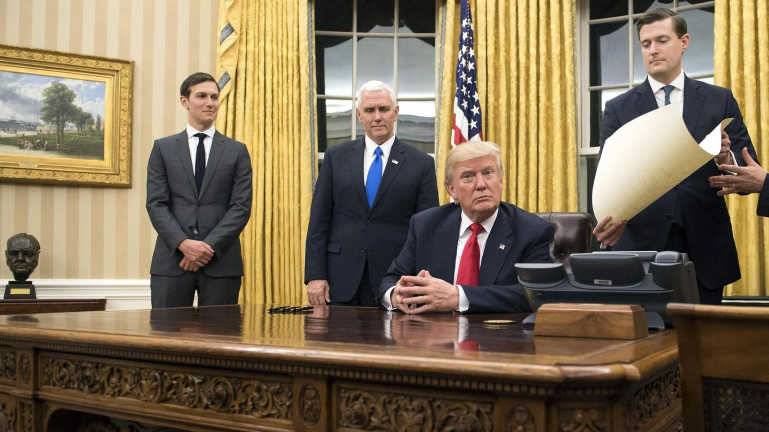
US President Donald Trump declined to clarify whether the American economy is heading for a recession following his administration’s shifting stance on tariffs imposed on key trading partners.
Trump Calls It a 'Period of Transition'
When asked if he anticipated a recession in 2025, Trump avoided a direct answer. Instead, he described the situation as a "period of transition," emphasizing that his administration’s economic policies are significant.
"I hate to predict things like that. There is a period of transition because what we're doing is very big. We're bringing wealth back to America. That's a big thing," Trump told
Fox News in an interview aired Sunday but recorded earlier in the week. "It takes a little time, but I think it should be great for us."
Commerce Secretary Rejects Recession Fears
Despite the uncertainty in financial markets, Commerce Secretary Howard Lutnick insisted that the US economy would not shrink. However, he acknowledged that some prices could rise due to new tariffs.
"Foreign goods may get a little more expensive. But American goods are going to get cheaper," Lutnick stated in an interview with
NBC. When asked directly if the US could enter a recession, he responded, "Absolutely not… There's going to be no recession in America."
Market Volatility and Trade War Escalation
US financial markets faced turbulence last week as investors reacted to policy reversals. Initially, the
US imposed 25% tariffs on imports from Mexico and Canada, only to exempt many of those goods within two days. Meanwhile, Trump doubled blanket tariffs on Chinese imports to 20%, prompting immediate retaliation from Beijing.
As of Monday, China has implemented new tariffs of 10 to 15% on select US agricultural products, including chicken, beef, pork, wheat, and soybeans.
Han Shen Lin, China country director at
The Asia Group, told the BBC: "You're seeing a lot of tit-for-tat between both sides to demonstrate that neither side will back off easily. That said, China has realized it probably can't export its way to GDP growth the way it used to, so it is focusing more on the domestic economy right now."
US Accuses Trade Partners, Faces Global Criticism
Trump has blamed China, Mexico, and Canada for failing to curb illegal drug trafficking and migration into the US—allegations all three nations have rejected.
Meanwhile, former US Commerce Department official Frank Lavin said he does not expect the trade war to spiral out of control. "Tariffs will eventually fade a bit," he told the BBC, "but they will still be an extra burden on the US economy."
Rachel Winter, an investment manager at
Killik & Co., warned of inflation risks. "Tariffs are theoretically inflationary, and the level of tariffs that Trump is imposing, I think no doubt, will have to cause inflation somewhere down the line," she said during an interview with the
Today programme.
As markets react to policy changes, investors remain wary of the economic fallout from the ongoing trade disputes.