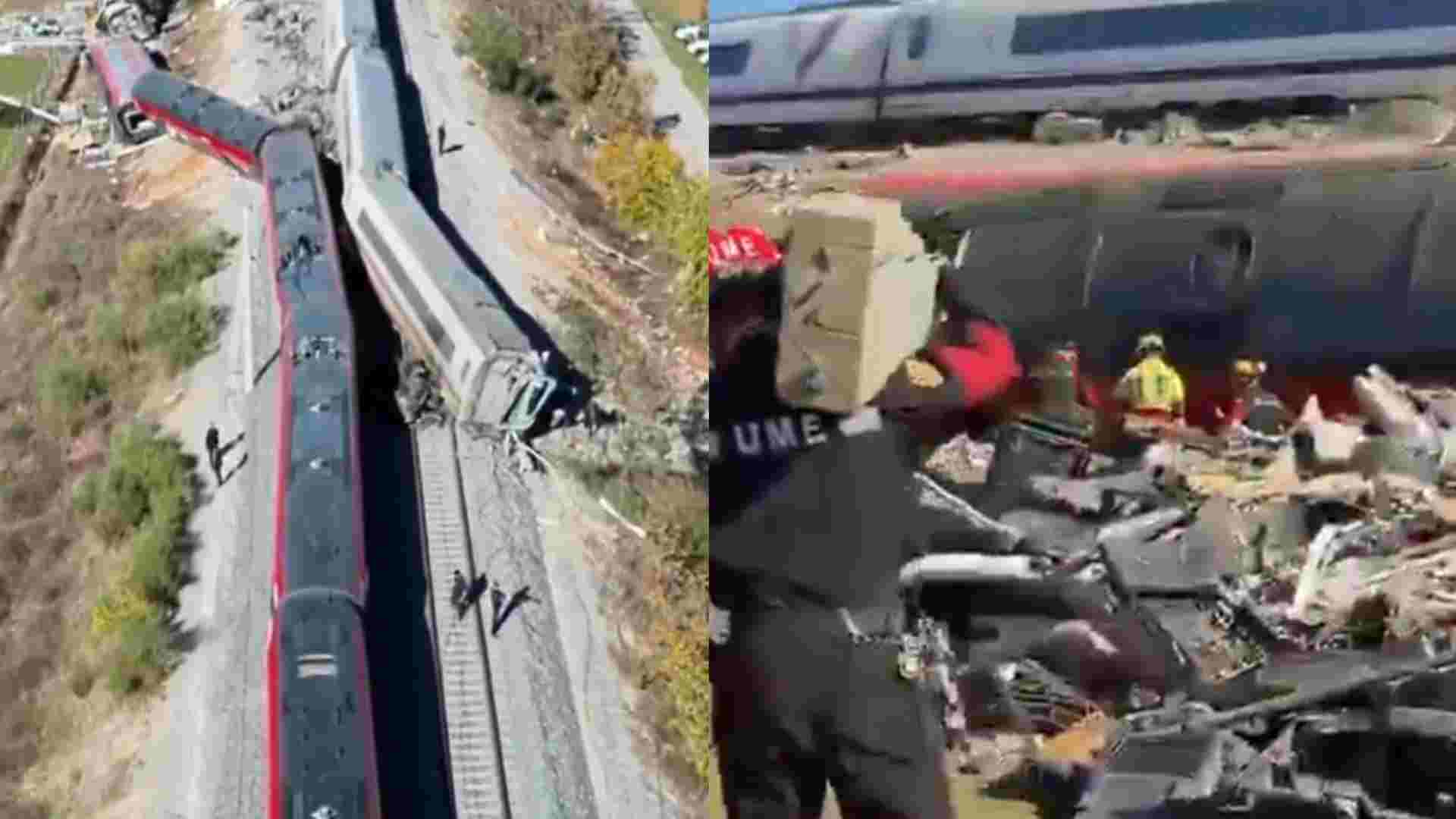
Spain’s Prime Minister Pedro Sánchez has announced three days of national mourning after a
collision between two high-speed trains near Urda, in the Toledo province, killed at least 68 people and injured more than 100 others.
The accident took place on Wednesday morning on the Madrid–Andalusia railway line. An Iryo high-speed train stopped on the tracks before a Renfe train travelling in the same direction crashed into it from behind. The impact derailed several carriages, leaving passengers trapped inside the damaged trains. Authorities said the two trains were carrying a combined total of 544 passengers.
“Today all of Spain is grieving,” Spanish Prime Minister Pedro Sánchez said during his visit to the accident site. He announced the three-day mourning period as the country began to come to terms with the tragedy.
According to the Associated Press, Sánchez also called for stronger railway safety measures to restore public confidence in Spain’s high-speed rail network, which has long been a source of national pride.
Signalling Failure and Control Centre Error
Transport Minister Óscar Puente said the accident followed a failure in the LZB automatic signalling system at around 08:30. A computer malfunction reportedly brought approximately six trains to a halt along a 63-kilometre section of railway track.
Following the disruption, responsibility for managing train movements shifted to the central control centre in Madrid. However, operators at the centre reportedly allowed at least two trains to resume normal operations even though a stop signal remained active.
Puente described the decision as “inexplicable” and “clearly wrong,” raising serious questions about the handling of the signalling failure and the decisions made by railway officials.
The Renfe train travelled for approximately 25 kilometres before colliding with the stationary Iryo service. The crash occurred around 17 minutes after the Renfe train resumed its journey. Authorities have not yet established the exact speed at which the Renfe train was travelling at the time of the collision. The affected section of track allows trains to operate at speeds of up to 200 kilometres per hour.
Investigators are expected to examine the signalling malfunction, the instructions issued by the control centre and the circumstances that allowed the Renfe train to continue towards the stationary service.
Rescue Operations Continue as Death Toll Could Rise
Emergency services continued searching through the wreckage on Wednesday afternoon as rescue workers attempted to locate survivors and recover victims from the damaged carriages.
Castilla-La Mancha regional president Emiliano García-Page warned that the death toll could increase as rescue teams continued their work. Authorities said 107 people had been taken to hospitals following the collision, with 15 remaining in serious condition.
The scale of the damage and the number of casualties have intensified concerns about railway safety and the effectiveness of emergency procedures.
Second Major High-Speed Rail Disaster This Year
The collision marks Spain’s second major high-speed rail disaster this year. In January, a separate accident near Adamuz in Andalusia killed 46 people and involved Renfe and Iryo trains.
The two major accidents within the same year have raised fresh concerns about the safety of Spain’s high-speed railway system.
Sánchez described the occurrence of two such disasters in a single year as “unacceptable.” He pledged that the government would investigate any safety failures or negligence and address them with the “utmost severity.”
His remarks signalled a commitment to establishing accountability and preventing similar accidents in the future.
Opposition Demands Independent Rail Safety Review
Opposition leader Alberto Núñez Feijóo called for a comprehensive and independent review of Spain’s national railway network. His demand adds to growing pressure on the government to establish the causes of the collision and assess whether existing safety procedures are adequate.
The tragedy also prompted public expressions of grief across the country. Authorities and communities held moments of silence to honour those who lost their lives.
In a further sign of national mourning, organisers postponed all 24 Copa del Rey football matches scheduled for Wednesday.
As rescue operations and investigations continue, the government faces mounting pressure to explain how the signalling failure and subsequent control centre decisions led to one of Spain’s deadliest railway accidents.