
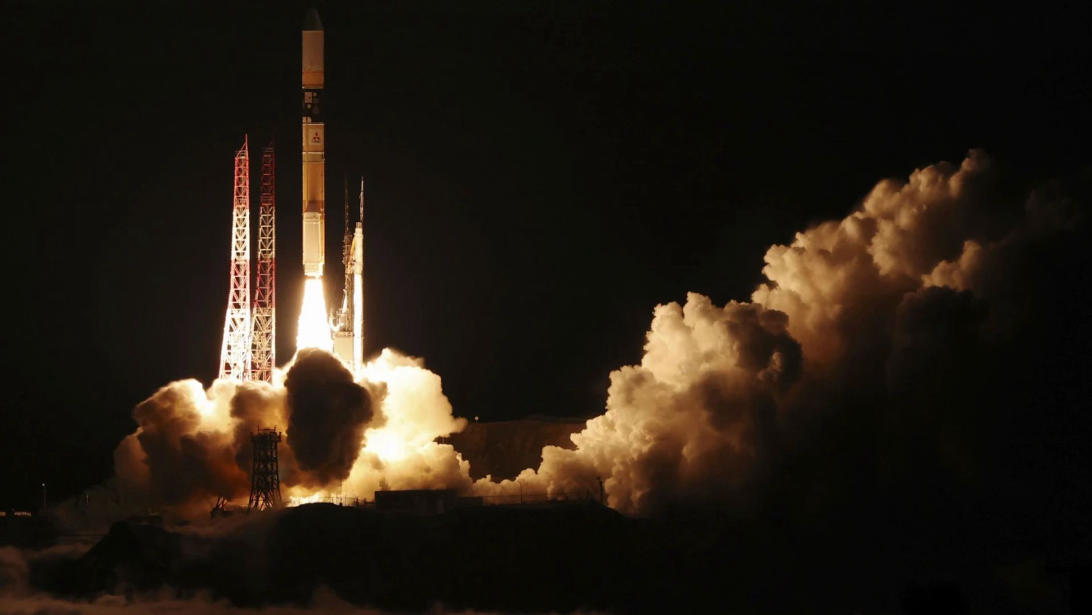

Japan launched the H-2A rocket for the last time on Sunday. The rocket carried a climate-monitoring satellite named GOSAT-GW. It lifted off from Tanegashima Space Center in southwestern Japan.
Soon after launch, the satellite separated from the rocket and entered its planned orbit—just 16 minutes later.
Launch Marks End of an Era
Importantly, this was the 50th and final flight for the H-2A rocket. Since its first flight in 2001, it had 49 successful launches and only one failure in 2003.
Although the mission faced delays due to electrical issues, the launch eventually succeeded. Scientists and engineers celebrated in the control room.
Leaders Share Emotional Reactions
Keiji Suzuki, who oversaw rocket operations, said, “I’ve spent my entire life at work not to drop H-2A rocket ... All I can say is I’m so relieved.”
Likewise, JAXA President Hiroshi Yamakawa called it, “a deeply emotional moment for all of us at JAXA as a developer.”
Satellite Will Help Track Climate Change
Meanwhile, the new satellite GOSAT-GW will monitor carbon dioxide, methane, and other greenhouse gases. It will also collect data on rainfall and sea surface temperature.
Within a year, it will start sharing data with organizations worldwide, including the U.S. National Oceanic and Atmospheric Administration.
H-2A Rocket’s Legacy in Space
Over the years, the H-2A rocket launched many major missions. For instance, it carried Japan’s Hayabusa2 asteroid probe in 2014 and the SLIM moon lander in 2023. Since 2007, Mitsubishi Heavy Industries managed the rocket’s operations. Overall, H-2A had a 98% success rate in its 23-year journey.
Japan Turns to H3 for Future Missions
Now that H-2A is retired, Japan will rely on the H3 rocket. This new rocket is cheaper, stronger, and better suited for global competition. Even though its debut in 2023 failed, the H3 has completed four successful launches since then. According to Suzuki, this transition allows engineers to focus fully on improving H3.
New Rockets to Serve Global Market
Japan also hopes to expand its space role by offering two new rockets: the large H3 and the smaller Epsilon, developed with IHI Corporation. Together, they aim to meet diverse customer needs and strengthen Japan’s commercial space presence.
Clearly, Sunday’s successful launch marked the end of one chapter and the start of another. With the retirement of H-2A, Japan looks to the future—hoping the H3 and Epsilon will take its space program to new heights.