
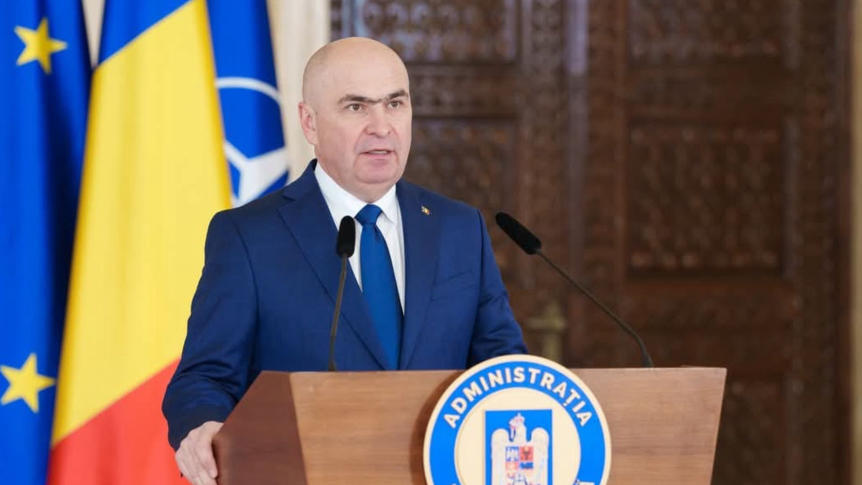

Romania's new president, Nicusor Dan, has chosen Ilie Bolojan to be the country's next prime minister. The announcement came on Friday and ended weeks of uncertainty after December’s presidential election was cancelled and re-run.
Bolojan leads the pro-European National Liberal Party (PNL). At 56, he is known for being a disciplined reformer. Until recently, he was serving as Senate president. Earlier this year, he briefly acted as president—from February to May—before Dan defeated a far-right challenger in the election rerun.
Romania Tries to Move Past Political Crisis
Romania, a member of both NATO and the European Union, has been stuck in a political crisis for over a year. Dan nominated Bolojan after holding new talks with leaders of PNL. The new prime minister now faces a huge task: fixing the country’s deepening budget crisis.
Tackling the Budget Crisis Is Bolojan’s Main Task
Bolojan’s top priority will be managing Romania’s financial troubles. The country’s budget deficit hit 9.3% by the end of last year—the highest in the EU, according to AFP.
Last week, Bolojan told reporters, “Romania is in a complicated situation.” He warned that the government would need to take “unpopular measures”, such as spending cuts and tax hikes.
Political expert Sergiu Miscoiu told AFP that Bolojan is “the person best placed to take unpopular measures to tackle the serious budget crisis.” Still, some analysts warn that Bolojan has “no experience in national politics” outside his short stint as interim president.
Divisions Remain After Heated Election
Romania is also dealing with deep social divisions exposed by the recent presidential election. According to Cristian Andrei, a political consultant based in Bucharest, the new government must build long-term consensus, especially on delayed state reforms.
Andrei told the Associated Press, “There is only a disputed agreement on very short-term measures for the economic and budget crisis.” He warned that if the short-term solutions cause inflation or hardship without deeper policy reform, “then the political crisis will loom over the next years and (future) elections.”
What Happens Next
Bolojan’s nomination must still be approved by parliament. According to Euro News, his proposed government will include several major parties:
-
The Social Democratic Party (PSD)
-
The PNL
-
The reformist Save Romania Union
-
The ethnic Hungarian UDMR party
Before the nomination, PSD pushed for a power-sharing deal, which would include rotating the prime minister's post. After being nominated, Bolojan said he is “fully aware of the great responsibility” and admitted the job “will not be an easy undertaking.”
He outlined three main goals:
-
“To restore order to the country’s finances,”
-
“To work toward good governance that creates conditions for development in Romania,”
-
“To show proper respect to the Romanian people.”
Far-Right Parties Left Out
Although far-right parties won one-third of the seats in parliament, they were excluded from government talks. Defeated far-right presidential candidate George Simion called this exclusion “a disgrace and an insult.”
At the same time, the European Union has raised concerns about the rise of Eurosceptic voices in Romania. Some of these parties oppose sending military aid to Ukraine, which has created tension within NATO and the EU.