
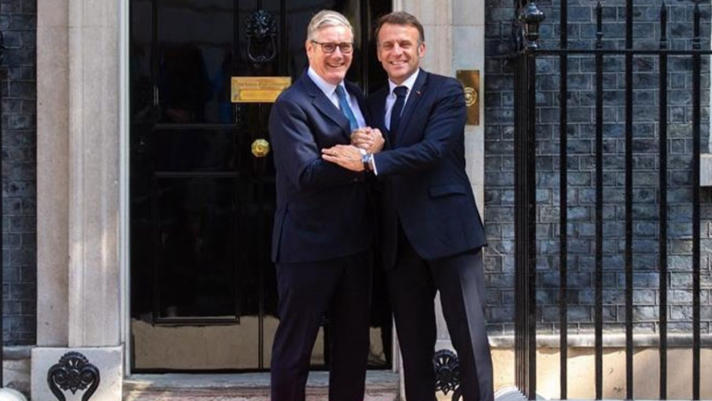

British Prime Minister Keir Starmer and French President Emmanuel Macron announced stricter migration measures on Thursday. The announcement came as Macron wrapped up his three-day state visit to the UK, which also resulted in new agreements on defence, nuclear cooperation, and joint support for Ukraine in case of a ceasefire with Russia.
A Diplomatic Boost for Starmer
During the high-profile visit, Macron was welcomed with a carriage ride to Windsor Castle alongside King Charles and honoured with a state banquet. But the key political moment came when Macron backed a new migrant returns deal, giving Starmer a much-needed lift.
Since winning by a landslide last year, Starmer has seen his approval ratings dip. Now, he faces mounting pressure to reduce immigration numbers, especially the rising number of asylum seekers crossing the Channel in small boats. This issue has also helped boost support for the right-wing Reform UK party, led by Nigel Farage.
“One In, One Out” Migration Plan
At a joint press conference, Starmer and Macron introduced a “one in, one out” returns scheme. Under this plan, the UK will send undocumented migrants back to France. In exchange, Britain will accept the same number of legitimate asylum seekers who have family in the UK.
Standing next to Macron, Starmer said, “I’m pleased to announce our agreement today on a groundbreaking returns pilot. For the very first time, migrants arriving in small boats will be detained and returned to France in short order.” He added, “This will show others trying to make the same journey that it will be in vain.”
Will the Plan Work?
However, it’s unclear how much the deal will change the current situation. According to Reuters, government sources say the pilot program would involve about 50 returns per week, which adds up to around 2,600 people a year. That number is small compared to the 35,000 migrants who crossed the Channel in small boats last year.
Still, officials believe the scheme could expand in the future. So far in 2025, over 21,000 people have already made the crossing—marking a record high for this time of year. Labour MP Fabian Hamilton expressed doubt, saying he was “sceptical that this is the answer.”
Macron Faces Pressure at Home
While the plan may help Starmer politically, it could hurt Macron.
His right-wing critics in France may question why he agreed to accept migrants who intended to stay in Britain.
Macron also used the occasion to criticize Brexit, saying, A lot of people in your country explained that Brexit would allow you to fight more efficiently against illegal immigration,” but it led to “the exact opposite.”
He further suggested that the UK should reduce “migration pull factors” by making it harder for undocumented migrants to find jobs. In response, Starmer defended his policies. He said the UK had launched a nationwide crackdown on illegal employment. The jobs migrants had been promised would no longer exist,” he added.
Deeper UK-France Defence and Ukraine Cooperation
Beyond migration, both leaders agreed to strengthen UK-France defence ties. They joined a call with countries from the “coalition of the willing”—a group of nations preparing to support Ukraine after a possible ceasefire with Russia.
On the call, Starmer told Keith Kellogg, the US envoy on Ukraine, that it was time to push Russian President Vladimir Putin to the negotiation table. However, he said Ukraine must first be in a strong military position.
France and the UK agreed to host the coalition’s headquarters in Paris, with London taking over after one year. The coalition will help rebuild Ukraine’s military, defend its skies, and protect its waters. “Supporting Ukraine is not just the right thing to do, it’s essential for delivering security at home,” said Starmer.
Nuclear and Missile Collaboration
Both countries also committed to ordering more Storm Shadow cruise missiles, already used in Ukraine. Additionally, they signed a nuclear cooperation deal. For the first time, this agreement allows the UK and France to coordinate their nuclear deterrents.
Starmer said, “As close partners and Nato allies, the UK and France have a deep history of defence collaboration and today’s agreements take our partnership to the next level.”