
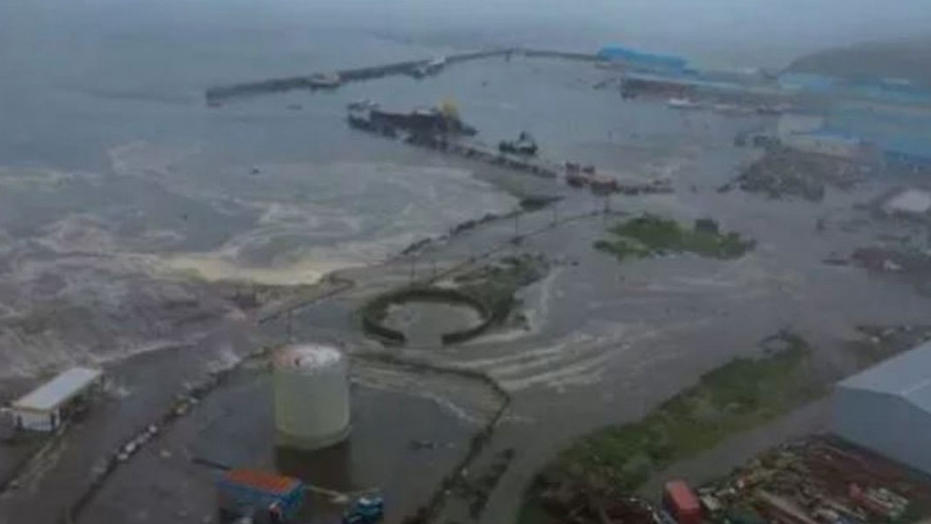

Tsunami warnings were lifted across the Pacific Ocean on Wednesday. This allowed millions of people who had evacuated to go back to their homes.
The alerts had been issued after a powerful 8.8-magnitude earthquake struck near Russia’s remote Kamchatka Peninsula. It was one of the strongest quakes ever recorded.
Widespread Alerts and Evacuations
The quake shook Russia’s Far East and led over a dozen countries — from Japan to the U.S. to Ecuador — to issue tsunami warnings. Authorities in these countries told people to stay away from coastlines.
Experts warned that waves as high as four meters (about 12 feet) could hit some areas in the Pacific.
Several ports and airports were shut. For instance, Peru closed 65 out of its 121 Pacific ports. In Hawaii, officials on Maui island canceled all flights.
However, as time passed, the threat decreased. One by one, countries began lifting the alerts and said it was safe for coastal residents to return.
Mass Evacuation in Japan and Chile
In Japan, officials had ordered nearly two million people to move to higher ground. The Fukushima nuclear plant — previously damaged in the deadly 2011 quake and tsunami — was briefly evacuated as a precaution.
Sadly, one person died in Japan. Reports said she drove off a cliff while trying to flee the area.
Chile also took major action. Officials called their response “perhaps the most massive evacuation ever carried out in our country.” Around 1.4 million people were asked to leave coastal areas. Thankfully, no injuries or damage were reported there. Waves reached only about 60 centimeters (2 feet) along the northern coast.
Calm Returns to Galapagos Islands
In Ecuador’s Galapagos Islands, people had been warned about waves up to three meters high. Fortunately, the situation remained under control.
The Ecuadorian navy’s oceanographic institute later said the danger had passed. Locals described how the sea level suddenly dropped and rose again — a usual sign of a tsunami. But only a one-meter surge occurred, which caused no damage.
“Everything is calm, I’m going back to work. The restaurants are reopening and the places tourists visit are also open again,” said Isabel Grijalva, a 38-year-old resident of Santa Cruz Island.
Earlier in the day, authorities had closed national parks, shut schools, used loudspeakers to warn people, and quickly brought tourists off sightseeing boats.
Worst Impact in Russia
Russia saw the most damage. A tsunami wave struck the port town of Severo-Kurilsk. It flooded a local fish processing plant and swept debris and buildings into the sea. According to the town’s mayor, Alexander Ovsyannikov, the water reached the World War II monument located 400 meters from the shore.
Despite the intensity of the earthquake — the strongest since 2011 — the damage in Russia remained limited. Only a few light injuries were reported.
Soon after the quake, the Klyuchevskoy volcano in the same region erupted. “Red-hot lava is observed flowing down the western slope. There is a powerful glow above the volcano and explosions,” said Russia’s Geophysical Survey.
Strongest Quake in Kamchatka Since 1952
Seismic experts confirmed that this was the strongest earthquake in the Kamchatka area since 1952. The US Geological Survey (USGS) said this was one of the ten most powerful quakes worldwide since 1900.
After the initial tremor, dozens of aftershocks followed. One aftershock reached 6.9 in magnitude. The USGS warned there was still a 59 percent chance of another aftershock stronger than 7.0 within the next week.