
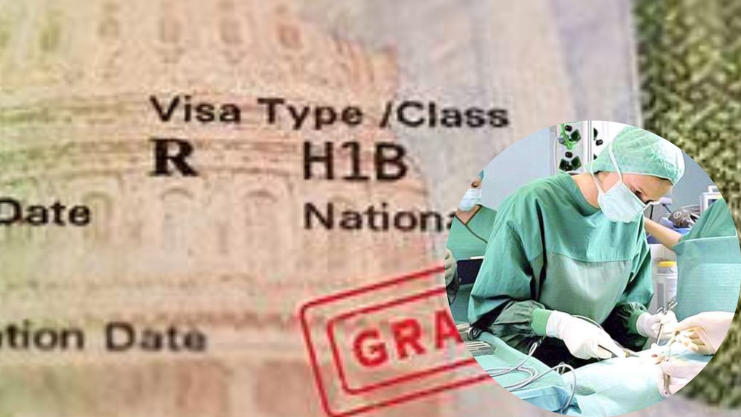

The White House hinted on Monday that doctors and medical residents may not need to pay the new $100,000 H-1B visa fee. White House spokesperson Taylor Rogers told Bloomberg News, “The Proclamation allows for potential exemptions, which can include physicians and medical residents.”
This announcement came after intense criticism from the medical community. Many health professionals warned that the fee would discourage international doctors from working in the US.
Medical Groups Warn of Shortages
In response to the new rule, the American Medical Association (AMA) expressed strong concerns. AMA President Bobby Mukkamala told Bloomberg, “The $100,000 fee for H-1B visas risks shutting off the pipeline of highly trained physicians that patients depend on, especially in rural and underserved communities.”
As a result, hospitals fear they will struggle to hire skilled doctors, particularly in regions already facing shortages.
Trump’s Proclamation and Its Purpose
Last week, President Donald Trump signed a proclamation introducing a $100,000 fee for every H-1B visa application.
According to the administration, this change will prevent companies from hiring lower-paid foreign workers to replace Americans. Officials also claim it will ensure that only the most skilled foreign professionals receive visas.
Commerce Secretary Howard Lutnick defended the policy, calling it a “necessary correction.” He explained that previous visa rules allowed low-wage workers, some dependent on government aid, to take jobs meant for US citizens.
Furthermore, Lutnick said the new fee would “eliminate the bottom quartile of applicants” and generate more than $100 billion for the US Treasury. President Trump stated that this revenue would help reduce the national debt and lower taxes.
Major Impact on Indian Tech Workers
This decision is especially significant for India. About 71% of all H-1B visa holders are Indian, most of whom work in the tech sector. Companies like Infosys, Wipro, Cognizant, and Tata Consultancy Services rely heavily on the program to send skilled workers to US projects.
Currently, H-1B visas last three years and can be renewed for another three. However, under the new rule, companies would need to pay $100,000 every time a visa is issued or renewed.
As a result, many employers may find it too costly to keep Indian professionals, especially since Green Card backlogs already leave workers waiting for decades.
Threat to India’s IT Industry
Moreover, the decision poses a serious challenge to India’s $250-billion IT services industry, which depends on US placements for growth.
If companies cut back on hiring due to high costs, opportunities for Indian engineers and developers could shrink. In turn, this may weaken India’s competitive edge in the global tech market.
US Tech Sector Reacts
Meanwhile, the US tech industry faces uncertainty. President Trump insisted that “big tech loves the idea.”
However, investors were not convinced. Reuters reported that shares of US-listed Indian IT companies dropped by 2% to 5% after the announcement.
Debate Over the New Policy
Supporters argue that the high fee will prevent wage suppression and encourage companies to train American graduates. On the other hand, critics warn that it will block international talent, harm innovation, and slow down the economy.
A White House memo criticized tech companies, stating, “Information technology (IT) firms in particular have prominently manipulated the H-1B system, significantly harming American workers in computer-related fields.”
What Lies Ahead
For now, the White House has not confirmed which groups will receive official exemptions. Until then, both the US healthcare system and the global tech industry are closely watching how the policy unfolds, especially to see if doctors will be spared from the steep visa fee.