
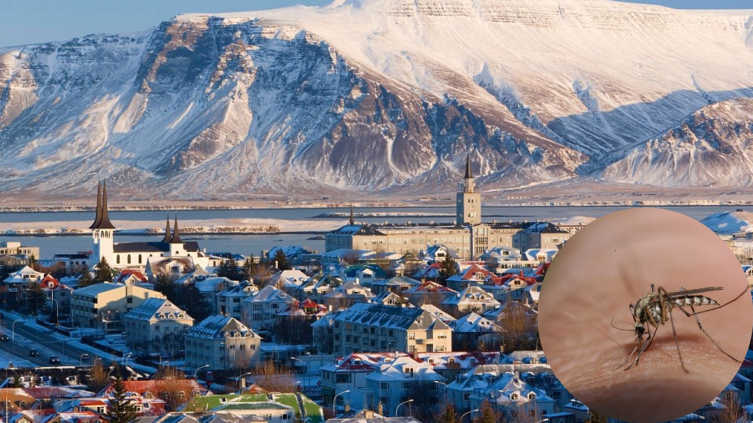

Iceland, known for its pristine, mosquito-free environment, has reported the presence of mosquitoes on its land for the first time in history. This marks the end of its long-standing reputation as one of only two mosquito-free regions in the world, the other being Antarctica.
Experts say this discovery clearly reflects the growing impact of climate change. The country’s warming climate is now providing suitable conditions for species that normally thrive in warmer regions.
Climate Change and Rising Temperatures
For years, scientists have warned that mosquitoes would eventually appear in Iceland. The nation’s many marshes and ponds make it ideal for mosquito breeding once the temperature becomes favorable. That prediction has now come true as Iceland is heating up at a much faster rate than most of the Northern Hemisphere — four times faster, to be exact.
The rapid warming has already caused visible changes. Glaciers are melting at alarming rates, and warm-water fish like mackerel are now appearing in Icelandic waters. These changing conditions have created an environment where the mosquito life cycle can now fully develop.
Discovery by a Citizen Scientist
The breakthrough finding was confirmed by Matthías Alfreðsson, an entomologist at the Natural Science Institute of Iceland. He examined three mosquito specimens—two females and one male—collected by a citizen scientist named Björn Hjaltason. The insects were found on a “wine rope” trap meant for moths in Kiðafell, Kjós.
Alfreðsson identified the species as Culiseta annulata, a type known for its ability to survive cold climates. This hardy mosquito can endure Iceland’s harsh winters by hiding in warm shelters such as barns, basements, or other enclosed structures.
Global Warning Sign
The arrival of mosquitoes in Iceland is part of a larger global trend. As temperatures rise worldwide, mosquitoes are spreading into regions that were once too cold for them. This expansion brings serious public health risks, as these insects are known carriers of dangerous diseases.
For instance, in the United Kingdom, scientists have recently detected eggs of tropical mosquitoes such as the Asian tiger mosquito. This species can spread severe illnesses, including dengue, chikungunya, and Zika virus.
A Symbol of the Changing Arctic
The appearance of mosquitoes in Iceland serves as yet another warning about how fast the Arctic and sub-Arctic regions are changing. Once protected by cold, the nation is now witnessing firsthand how global warming is reshaping ecosystems — from melting ice and shifting marine life to the arrival of entirely new species like mosquitoes.