
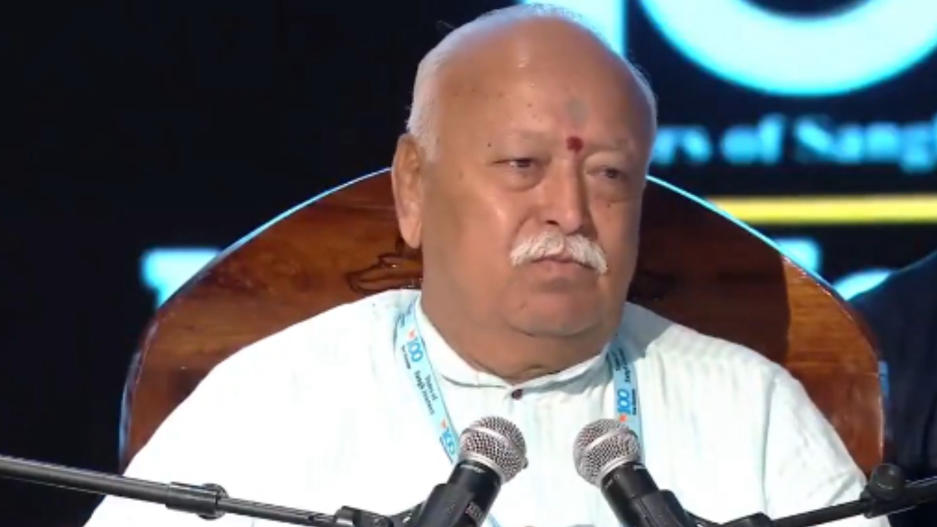

RSS chief Mohan Bhagwat strongly defended why the Rashtriya Swayamsewak Sangh (RSS) is not a registered organisation. Speaking in Bengaluru on Sunday, November 9, he said, “Many things are not registered. Even Hindu dharma (religion) is not registered.”
He reminded the audience that the government has already recognised the RSS through its past actions. Bhagwat said, “If we were not there, whom did they ban?” He referred to the three occasions when the organisation faced bans, suggesting that such actions proved its existence and influence.
This response came amid rising tension between the RSS and the Congress-led Karnataka government, which has restricted RSS activities in public spaces. Minister Priyank Kharge has repeatedly called RSS a “communal” organisation.
RSS Didn’t Need Registration, Says Bhagwat
Bhagwat also questioned the very idea of registration. He asked, “Should we have registered RSS with the British government as it was established in 1925?”
He pointed out that after India’s Independence in 1947, no law required the RSS to register. Furthermore, he noted that both the Income Tax Department and the courts have accepted that the RSS is a body of individuals. As a result, it enjoys tax exemption.
Through this, Bhagwat highlighted that the organisation operates transparently and within legal boundaries.
RSS Works for Society, Not Political Power
A day earlier, while addressing another event in Bengaluru, Bhagwat made it clear that the RSS’s mission is social, not political. He said, “When an organised force is raised in the form of Sangh, it doesn’t want power. It doesn’t want prominence in society. It just wants to serve, organise the society for the glory of Bharat Mata (Mother India).”
He noted that many people once doubted the Sangh’s intentions, but opinions have changed. “Somehow, in our country, people found it very hard to believe, but now they believe,” he said.
Bhagwat also tied the Sangh’s work to India’s cultural roots. He stated, “Sanatan Dharma is Hindu Rashtra and the progress of Sanatan Dharma is the progress of Bharat.”
RSS Faced Challenges and Opposition
Bhagwat reminded the audience that the RSS’s journey was not easy. He said, “There were two bans; a third as well, but it was not much of a ban. There was opposition, criticism. Swayamsevaks were murdered. In every way, it was tried that we should not thrive. But Swayamsevaks give their all to the Sangh and don’t want anything in return.”
He stressed that the RSS does not exist to oppose anyone. Instead, it aims to bring society together. “It is not in opposition to anything. It is an organisation ‘of’ the society, not ‘in’ the society,” he explained.
By highlighting these struggles, Bhagwat underlined the organisation’s endurance and commitment to its values.
All Indians Share Common Culture, Says Bhagwat
Bhagwat also emphasised unity across religious lines. He said all Indians share the same ancestry and cultural roots, regardless of their faith. “There is no ‘Ahindu’ (non-Hindu) in India,” he stated. “Everyone in India is a descendant of the same ancestors, and the core culture of the country is Hindu.”
He added that the RSS aims to unite all 142 crore Indians, regardless of differences. “We want to organise the Hindu society — all 142 crore people with so many religious denominations. And some of them came from outside during the course of history,” he said.
To build this unity, he said the RSS has started dialogues with groups who do not identify as Hindus. According to him, communication and understanding are essential to strengthen India’s social fabric.