
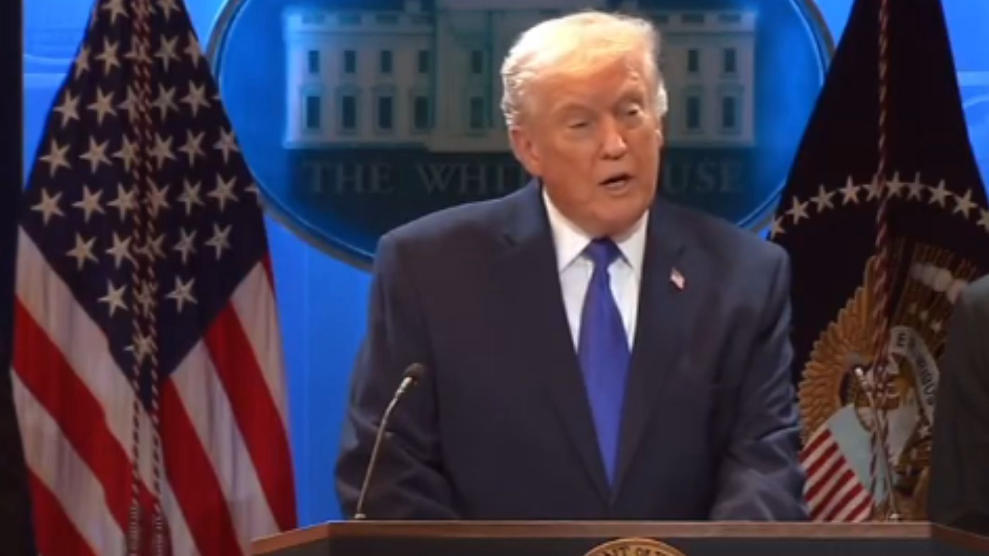

US President Donald Trump sharply criticised the Supreme Court of the United States after it ruled that his wide-ranging global tariffs were unlawful. He described the judgment as “deeply disappointing” and accused some justices of acting under the influence of “foreign interests”.
However, within hours of the ruling, Trump announced a new 10 percent global tariff. He said he would impose it under a different trade provision known as Section 122.
Court blocks use of emergency law
The court ruled 6-3 that the 1977 International Emergency Economic Powers Act, or IEEPA, does not give the president the authority to impose tariffs. Trump had relied on this law to justify his sweeping global duties.
The conservative-majority bench made it clear that the law was not designed for tariff powers. Chief Justice John Roberts said, “IEEPA contains no reference to tariffs or duties.”
The court further noted that “had Congress intended to convey the distinct and extraordinary power to impose tariffs” under IEEPA, “it would have done so expressly, as it consistently has in other tariff statutes.”
Three liberal justices joined three conservatives in forming the majority. The decision also upheld earlier lower court rulings that found Trump’s IEEPA-based tariffs illegal.
Trump reacts strongly
Trump responded angrily to the decision. Although he had nominated two of the justices who ruled against him, he publicly criticised certain members of the court.
“I’m ashamed of certain members of the court, absolutely ashamed, for not having the courage to do what’s right for our country,” Trump told reporters.
At the same time, he claimed the ruling had actually strengthened his position. “The Supreme Court’s decision today made a president’s ability to both regulate trade and impose tariffs more powerful and more crystal clear, rather than less,” he said.
He added, “In order to protect our country, a president can actually charge more tariffs than I was charging in the past,” and insisted that the outcome left him “more powerful.”
Kavanaugh dissents
Among the justices, Brett Kavanaugh was the only Trump nominee who sided with him. Kavanaugh issued a dissent and was joined by fellow conservatives Clarence Thomas and Samuel Alito.
Major setback in second term
The ruling marked Trump’s most significant loss at the Supreme Court since returning to the White House last year.
During his second term, Trump had used tariffs extensively as a tool for economic pressure and diplomatic negotiations. He invoked emergency economic powers to impose duties on nearly all US trading partners. These included “reciprocal” tariffs on countries that Washington considered unfair in trade practices. He also targeted Mexico, Canada and China with separate duties related to immigration issues and illicit drug flows.
However, Friday’s decision does not affect sector-specific tariffs on imports such as steel, aluminium and other goods. Those duties were imposed under different legal authorities. In addition, several government investigations remain ongoing and could result in new sectoral tariffs in the future.
Backup plan in place
Soon after the ruling, Trump said he had a “backup plan” to continue pursuing punitive duties. He quickly moved to activate Section 122, introducing a uniform 10 percent global tariff.
Although the court limited his use of IEEPA, Trump signalled that he would rely on alternative statutory powers to continue his aggressive trade agenda.