
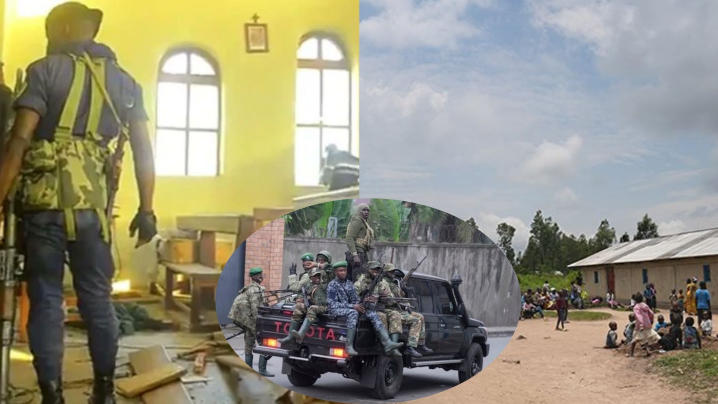

Early Sunday morning, Islamic State-linked rebels launched a brutal attack on a Catholic church complex in Komanda, a town in eastern Democratic Republic of Congo. As a result, more than 21 people were killed. The attackers also burned homes and shops, leaving behind scenes of destruction and fear.
The assault began around 1 a.m., according to witnesses. Members of the Allied Democratic Forces (ADF) carried out the attack. This group has pledged allegiance to the Islamic State and continues to target civilians in the region.
Death toll may rise
Local civil society leader Dieudonné Duranthabo confirmed the tragedy. He said, “Three of the victims were found burnt,” and warned that the number of dead could increase. “We need immediate military support — the enemy is still close,” he added.
Army confirms the attack
Meanwhile, military officials verified the incident. Lt. Jules Ngongo, spokesperson for the army in Ituri province, said, “At least 10 people were killed in a machete attack on a church near the town.” He further noted that nearby shops were also set on fire.
ADF expands its terror campaign
Originally formed in Uganda during the 1990s, the ADF moved into Congo in 2002 after facing military pressure. Since then, it has carried out a series of violent attacks, killing thousands of civilians. Its leaders want to build an Islamic state in the region.
Recently, the group was also blamed for another massacre in Ituri province. The United Nations condemned that attack and described the situation as a “bloodbath.” Now, the Komanda attack has added to the growing fear across the region.
Residents flee in fear
As a result of the latest violence, many residents of Komanda have started fleeing toward Bunia, a nearby city. Duranthabo criticized the government’s weak security measures. Despite a military presence in the town, people feel unsafe and vulnerable.
Government faces multiple threats
At the same time, Congo’s army is also fighting another rebel group — the M23. The Kinshasa government accuses Rwanda of supporting M23, which has intensified tensions in the region.
Consequently, the Congolese army now faces growing pressure on two fronts — defending civilians from the ADF and containing renewed clashes with the M23.