
JUSZnews

NEWS WITHOUT INTERRUPTION

Subscribe
Los Angeles Wildfire Tragedy: Death Toll Rises as Fires Spread
Devastating wildfires in Los Angeles have claimed five lives, destroyed over 1,000 structures, and forced tens of thousands to evacuate.

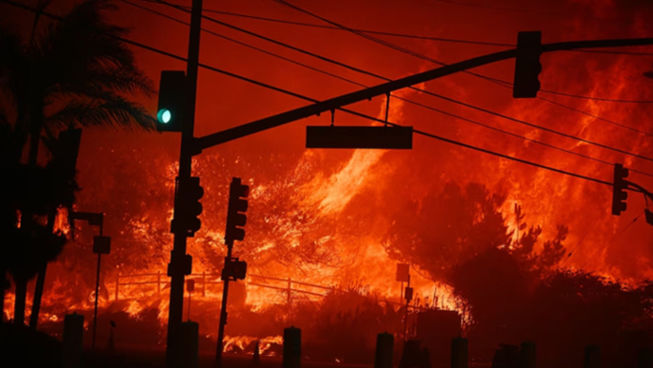
At least five people died in the devastating wildfires spreading across Los Angeles, officials reported Wednesday. Firefighters struggle to keep up with the rapid, intense flames.
Massive Evacuations and Property Destruction

Over 1,000 structures burned in these fires around the United States' second-largest city, forcing tens of thousands to evacuate their homes. Consequently, strong hurricane-like winds fueled the fires, creating fireballs that jumped from house to house in the affluent Pacific Palisades neighborhood. This area, popular among Hollywood stars, saw significant destruction of valuable real estate.

Firefighting Efforts Overwhelmed

Los Angeles County Fire Chief Anthony Marrone acknowledged the overwhelming nature of the disaster. "We’re doing our best. But no, we don’t have enough fire personnel in LA County to handle this," he admitted. As a result, by Wednesday afternoon, the fire in Pacific Palisades had burned about 16,000 acres (6,500 hectares), destroying 1,000 homes and businesses.

Additional Fires Spread Further

Another fire, covering 10,600 acres, raged around Altadena, north of Los Angeles, tearing through suburban areas. Los Angeles County Sheriff Robert Luna updated the death toll from two to five, fearing more casualties. “Unfortunately, it’s grown to five as we continue through this area,” Luna told radio station KNX. He added, “This is still a very fluid situation. There’s zero containment on this fire. I’m really praying we don’t find more, but I don’t think that’s going to be the case.”

Evacuation Orders and Injuries

Authorities issued evacuation orders for about 70,000 people in the region. Consequently, many who didn’t evacuate in time suffered significant injuries, Marrone said.

Water Shortages Complicate Efforts

Water shortages posed a severe challenge, with fire hydrants in Pacific Palisades running dry. Janisse Quinones, CEO of the Los Angeles Department of Water and Power, urged residents to conserve water. “We’re fighting a wildfire with urban water systems, and that is really challenging,” she explained.

Misleading Claims and Political Responses

President-elect Donald Trump wrongly claimed on social media that the water shortage was due to California's environmental policies. In fact, most of Los Angeles’ water comes from the Colorado River, with agriculture consuming the majority, not residential use or firefighting. Meanwhile, President Joe Biden, alongside California Governor Gavin Newsom, described the situation as "astounding." Biden assured reporters, “We’re doing anything and everything, as long as it takes, to contain these fires.”

Costly Destruction in Pacific Palisades

The Pacific Palisades fire, having destroyed possibly hundreds of multimillion-dollar homes, may become one of the most expensive fires on record. Martin Sansing, a resident of Santa Monica canyon for 20 years, expressed disbelief at the situation. “We’re in a pretty urban area. We’re not on a hill or anything like that. I never imagined we would be affected,” he said.

Personal Accounts and Power Outages

Sarahlee Stevens-Shippen, another resident, shared her experience of evacuating. “You got the ashes to worry about in your lungs. You got your life to worry about with these 80 to 100 mile an hour gusts. We’ve just been in panic mode,” she explained. More than 1.5 million households in the region lost power, as utilities often shut down power lines during high winds to prevent new fires.

Climate Change and Its Role

Wildfires are common in the western United States and play a crucial role in the ecosystem. However, scientists say human-induced climate change is altering weather patterns. Southern California experienced two decades of drought, followed by two wet years, which led to increased vegetation growth, creating more fuel for fires.

Meteorological Insights

Meteorologist Daniel Swain noted that the fierce winds, reaching up to 100 miles (160 kilometers) per hour, were stronger than the typical seasonal Santa Ana winds. He emphasized, “The winds are the driver, but the real catalyst… is this incredible antecedent dryness.” Swain added, “The lack of rain and the anomalous warmth and dryness we’ve seen the past six months is something we haven’t seen in records going back to the 1800s.”

Leave a Reply

Your email address will not be published. Required fields are marked *